Sustainable Aviation Fuel: Fuelling the Future
9 minute read | August.17.2026
The sustainable aviation fuel (SAF) sector is at an inflection point. Following the precedent set by the European Union in 2023 and the United Kingdom in 2025, countries around the world are proposing or implementing SAF blending mandates, voluntary blending programmes or tax and subsidy incentives to encourage SAF supply and production.
Approaches to SAF
|
Mandatory Blending |
|
EU · UK · Brazil · India |
|
Suppliers may be legally required to blend a rising minimum % of SAF into jet fuel. |
|
Voluntary Blending |
|
China · UAE |
|
Government-encouraged but not legally mandated SAF uptake. |
|
Incentive-Driven |
|
United States · Canada |
|
Government offers tax credits, grants or other financial incentives to encourage SAF production and use. |
The World Economic Forum has observed that the conflicts in Ukraine and the Middle East have strengthened the case for SAF by exposing the vulnerability of conventional fuel supply chains and accelerating interest in domestically produced alternatives. However, SAF mandates are outpacing available supply. Of the hundreds of SAF production projects announced in the last decade, only a small percentage are operational or under construction. In June 2026, the International Air Transport Association (IATA) estimated that SAF will account for only 0.8% of airline fuel used globally in 2026 — although current estimates suggest the EU and UK mandates for 2025 were met, with official compliance reports expected by year-end. IATA attributed the shortfall partly to poorly sequenced government policies, calling for accelerated investment in essential infrastructure and incentives to help the aviation industry meet its global targets.
|
SAF PATHWAYs |
STATUS |
|
HEFA (Hydro-processed Esters and Fatty Acids): Most commercially mature SAF, produced by refining oils and fats into jet-range hydrocarbons through hydro-processing |
Commercially Mature |
|
Non-HEFA Biofuels: Derived from waste and residue feedstocks such as municipal solid waste, agricultural residues and forestry residues |
Developing |
|
Power-to-Liquid (PtL) / eSAF: Synthetic fuel produced using renewable power, water and captured CO₂. The technology is developing rapidly but is not yet commercially viable at scale |
Emerging |
|
Non-PtL: Gasification-Fisher-Tropsch (FT), Bio Methanol-to-Jet and Alcohol-to-Jet (Ethanol) |
Developing |
UK SAF Mandate
In force since 1 January 2025, the UK’s SAF Mandate (the UK Mandate) requires suppliers to blend increasing proportions of SAF into jet fuel – starting at 2% in 2025 and increasing to 22% by 2040. From 2027, the use of HEFA-based SAF will be capped. The UK Mandate imposes two obligations on parties supplying 468,000 litres or more of fossil jet fuel per year. The “Main Obligation” requires SAF to be supplied in increasing proportions, with HEFA’s permissible contribution of total SAF decreasing from 100% (through 2026) to 71% by 2030 and 35% by 2040. A separate “PtL Obligation” requires 0.2% of total jet fuel supply from PtL sources in 2028, rising to 3.5% by 2040.
|
Trajectory of the UK SAF Obligations |
||||
|
Obligation |
2026 |
2028 |
2030 |
2040 |
|
SAF minimum % of total fuel |
3.6% |
6.8% |
10% |
22% |
|
SAF % of total fuel |
3.6% |
6.6% |
9.5% |
18.5% |
|
HEFA cap as % of Main Obligation |
100% |
87.88% |
74.74% |
42.16% |
|
PtL % of total fuel |
0% |
0.2% |
0.5% |
3.5% |
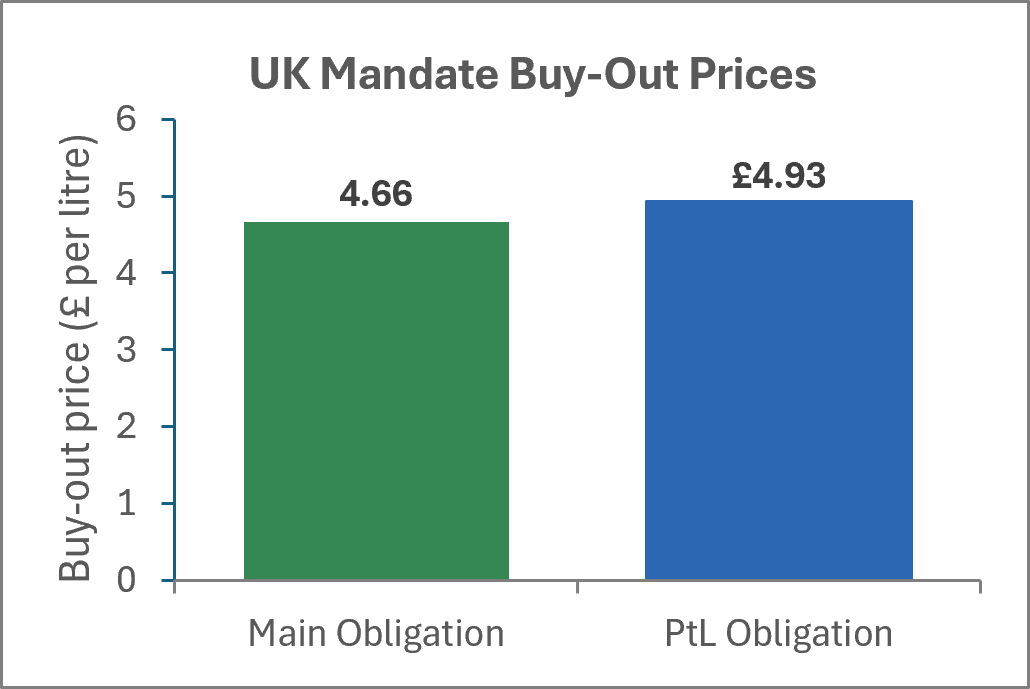
Suppliers unable to meet either obligation may buy out at rates prescribed by the UK Government. The buy-out price effectively sets a ceiling on SAF costs, preventing extreme price spikes from creating an undue burden on passengers.
The UK Government issued a call for evidence (closed on 28 July 2026) seeking industry views on non-HEFA supply and the issue of tankering (i.e. airline practice of carrying sufficient fuel to complete both legs of a journey to avoid refuelling at a higher price at its first destination). On 16 June 2026, the UK Government also announced a new £219 million low carbon fuels fund (which builds on the existing advanced fuels fund) to support UK companies in developing and scaling up SAF production.
EU SAF Mandate
The EU has a parallel but distinct framework. Adopted in October 2023, the ReFuel EU Aviation Regulation (Regulation (EU) 2023/2405) requires fuel suppliers at EU airports to blend increasing portions of SAF into jet fuel starting from 2% in January 2025 and rising in stages to 70% by 2050. There is a similar sub-quota for synthetic aviation fuel blends (such as certified e-kerosene) to be brought into the mix, starting with 1.2% in 2030 and scaling up to 35% by 2050. Our next briefing will cover the EU SAF Mandate in detail.
Revenue Support
To encourage SAF production and supply, both the EU and the UK are adopting a carrot and stick approach by pairing compliance obligations with financial support mechanisms. To complement the UK Mandate, the UK Government is developing a Revenue Certainty Mechanism (RCM) modelled on the contracts for difference (CfD) framework used in renewables. The EU is exploring parallel options under its Sustainable Transport Investment Plan (STIP), including a double-sided auction process.
UK RCM: SAF producers will contract with a government-backed counterparty (expected to be the Low Carbon Contracts Company) at a guaranteed strike price per litre. If the market price falls below the strike price, the counterparty pays the difference; if it exceeds the strike price, producers repay the surplus. In effect, producers carry demand risk while the counterparty carries price risk. The first contracts will be limited to non-HEFA SAF. On 13 July 2026, the UK Government published a contract allocation strategy for the RCM, confirming that the first SAF Allocation Round (SAF AR1) will open for applications in Q1 2027, with contracts expected from Q4 2028. The RCM will be funded through a variable levy on aviation fuel suppliers subject to the UK Mandate, calculated by reference to their market share of fossil-based aviation turbine fuel. Key commercial terms — including the strike price, reference price, floor price and contract length — remain under development. The UK Government recently published its response to the October 2025 consultation on the RCM, acknowledging concerns over scheme costs and sector competitiveness and issued a second consultation on the levy design (closed 2 August 2026).
EU STIP: The EU does not have an equivalent RCM, but the European Commission announced the STIP in November 2025, recognising the need to "provide revenue certainty and de-risk investments" and "unlock investments and scale up production of renewable and low-carbon fuels". Among the options under consideration is a double-sided auction in which a market intermediary offers long-term supply contracts to fuel producers — providing the offtake and revenue certainty needed to secure project financing — while reselling fuel to buyers under short-term contracts. The initiative is being developed with input from the eSAF Early Movers Coalition (eight Member States: Austria, Finland, France, Germany, Luxembourg, the Netherlands, Portugal and Spain).
The European Commission also announced a series of financial investments to increase commercial confidence in the sector which is expected to make at least €2.9 billion of funding available by the end of 2027. This includes €300 million to support the production of hydrogen for SAF and maritime (SMF) fuels through the European Hydrogen Bank, €133 million for research and innovation projects under Horizon Europe and €153 million for SAF fuels projects under the Innovation Fund. However, the STIP itself estimates that investment of at least €100 billion is required by 2035 to drive production and meet the commitments set in the ReFuel EU Aviation Regulation.
Will SAF land?
Achieving Bankability and Investability
The path to scale is not straightforward. Significant gaps remain between ambitious government mandates and achievable physical production. The single largest roadblock is attracting debt and equity finance at the scale required – in short, achieving bankability.
A bankable and investable project requires certainty in at least three areas that are currently lacking: (1) proven technology; (2) competitive capex and opex; and (3) long-term take-or-pay style offtake contracts. Advanced pathway technologies remain unproven at scale, production costs are high (particularly given the large volumes of baseload renewable power required) and long-term offtake arrangements are scarce. As a result, SAF projects struggle to meet the requirements of traditional project finance lenders. The UK Government’s RCM is intended to address price certainty and mitigate concerns over the considerable upfront costs required to develop such nascent technologies and projects. An offtake stack with a diversified pool of offtakers and medium-term offtake tenors may also help close the bankability gap.
Additional Concerns
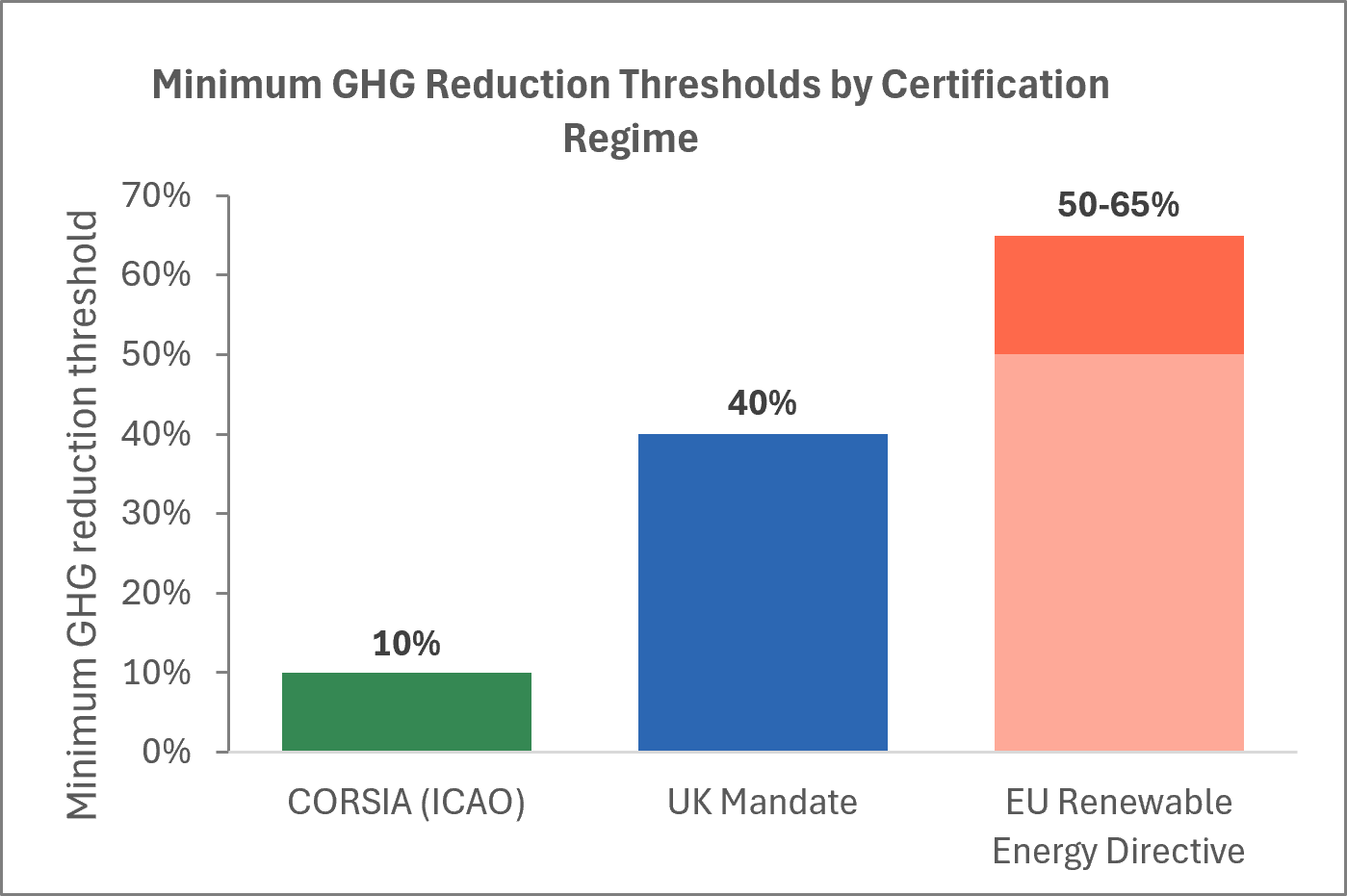
Certification: SAF must be certified by a third-party (such as the International Sustainability and Carbon Certification or Roundtable on Sustainable Biomaterials) for its supply to be eligible for issuance of a SAF compliance certificate (demonstrating a supplier’s compliance with its greenhouse gas emissions reduction obligations). The process is complicated by widely varying greenhouse gas reduction thresholds across certification regimes. Producers selling across jurisdictions may need multiple certifications with distinct criteria, creating compliance complexity for organisations operating across several overlapping regimes.
Feedstock constraints and domestic supply issues: HEFA – the most commercially mature SAF – faces competing feedstock demands that limit long-term scalability and, if produced at scale, could increase food prices. eSAF avoids biological feedstock constraints but remains energy-intensive and commercially unproven at scale. Projected 2030 prices for bio-based SAF and eSAF are two to twelve times higher than conventional jet fuel. A technical report published by the European Union Aviation Safety Agency (EASA) in October 2025 estimated that 68% of the feedstock used in EU SAF production comes from outside the EU, with China supplying 38% and Malaysia a further 12%. Feedstock transportation forms part of the life-cycle emissions calculation under frameworks such as the Carbon Offsetting and Reduction Scheme for International Aviation (CORSIA), so reliance on feedstock shipped over long distances raises questions about the genuine emissions benefit of certain SAF supplies. As mandates ramp up, the ability to deliver real energy security and emissions reductions may depend as much on feedstock supply chains as on production capacity.
Although the challenges facing a SAF developer today may seem daunting, renewable power in the UK was in a similar position roughly 20 years ago – nascent, high-cost, unproven and dependent on subsidy support. Today, direct corporate procurement of renewable power and routine commercial bank lending to the sector are established market features. That transformation was achieved through a combination of sustained policy intervention and private sector cooperation – features closely mirrored by the UK and EU Mandates and the contemplated complementary revenue certainty mechanisms. There is good reason to believe the same trajectory is achievable for SAF.
Connect with Orrick’s Global Oil & Gas team at [email protected] to discuss your next project, investment or strategic initiative.