Deal Flow 6.0: 5 Things We Learned About European Tech Deal Terms in 2025
2 minutes | March.31.2026
2025 was the year Europe started rebuilding. AI, climate tech, deep tech, better governance and renewed M&A activity provided stability. Valuations and deal volumes showed signs of normalizing, but the market remained disciplined and efficient, with founder-investor alignment structurally stronger than it has been in years.
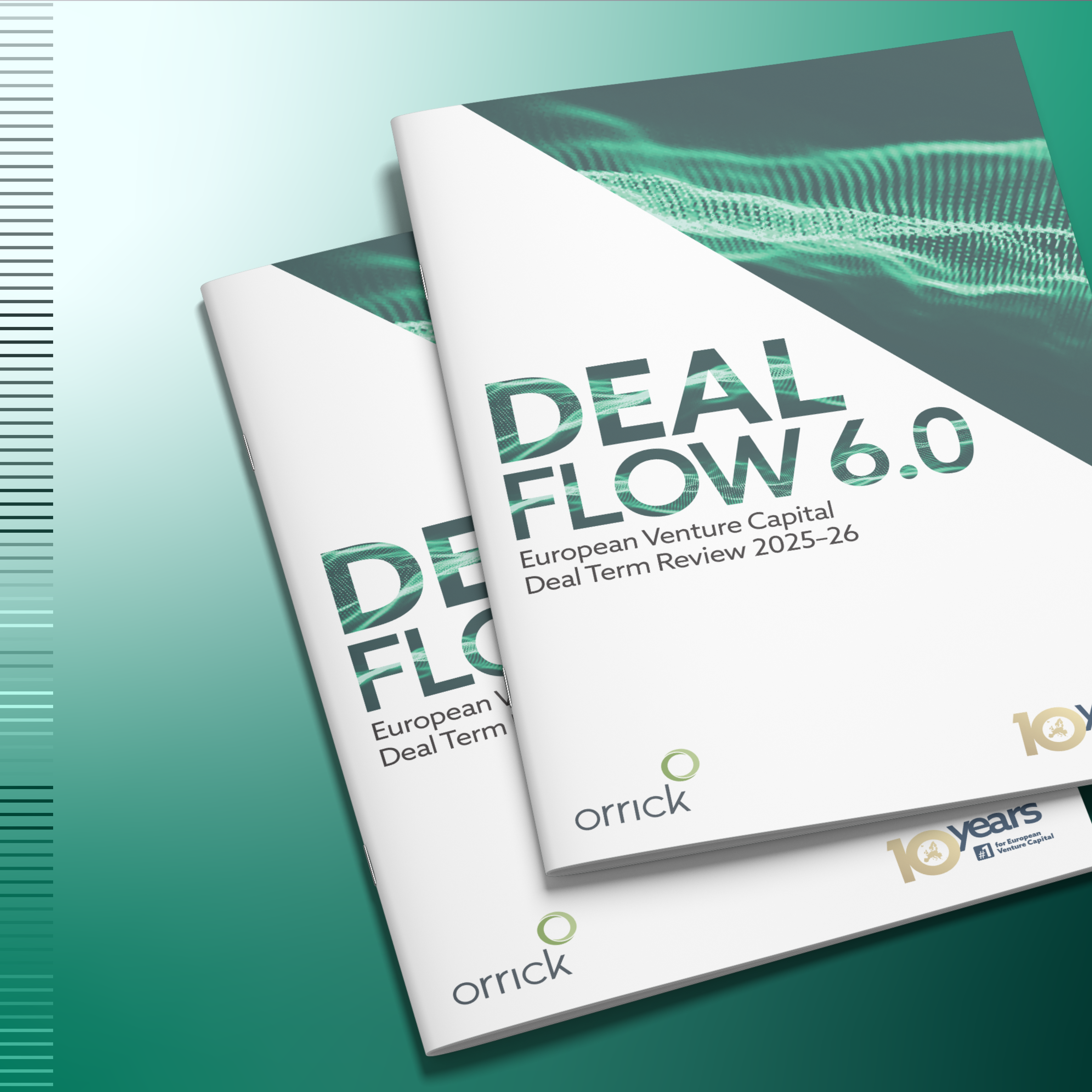
To understand the factors driving these shifts in the landscape and their effect on deal terms, we used our award-winning proprietary tool, the Deal Flow Dashboard, to analyze over 400 venture capital and growth equity investments completed by our clients in Europe last year.
Here are five key things we learned:
- The Market Has Stabilized — But at a Lower Baseline
After two years of volatility and muted activity in 2024, 2025 marked the first year of true stabilization:
- Deal volume fell but soon began a slow recovery.
- Valuations stopped compressing but did not revert to 2021 peaks.
- Late-stage rounds remained constrained but no longer in freefall.
Key lesson: The European market has found a new normal: disciplined pricing, fewer megadeals and more pragmatic investor expectations.
- AI Remains Dominant — Especially Applied, Vertical and Infrastructure AI
AI is the primary engine of European VC activity. In 2025, we closed 170 AI financings across Europe, valued at $6.25 billion. The deep tech sector—including AI and ML—represented 35% of all venture financings and CLNs, making it the single largest sector by deal share. This dominance is driven by:
- Enterprise adoption of LLMs and agent frameworks.
- Strong rounds in model-adjacent infrastructure (data orchestration, vector DBs, chips).
- Verticalized AI (healthcare, legal, manufacturing, fintech) receiving major checks.
- UK, France and Germany emerging as distinct AI clusters.
- Investors Shifted Back to Fundamentals: Profitability, Efficiency and Governance
2025 saw a return to disciplined investing. The data bears this out with 77% of deals featuring a 1x non-participating liquidation preference (with less than 1% carrying a participating preference) and 79% of deals including broad-based weighted average anti-dilution. 56% investment documents contained ESG provisions. Specific features included:
- Heightened focus on revenue quality and path to profitability.
- Fewer "growth at all costs" deals.
- Increased use of structured terms (discounts, tranched rounds, milestone-based investments).
- Heavier diligence on data governance, ML-ops and security.
- Adoption of AI-related warranties driven by early EU AI Act implementation.
Key lesson: Governance, compliance and business-model defensibility matter again — and are increasingly decisive in term-sheet negotiations.
- Climate Tech, Deep Tech and Industrial Software Are Europe's Other Bright Spots
Beyond AI, the healthiest verticals in 2025 were:
- Climate and energy transition (battery tech, carbon removal, grid orchestration) accounted for 10% of financings.
- Industrial software (manufacturing automation, IoT, supply-chain optimisation).
- Blockchain & fintech accounted for 18% of financings in 2025, up from 16% in 2024 (and 12% in 2023).
- SaaS & platforms represented 17% of financings in 2025, continuing a decline from 21% in 2024 and 31% in 2023.
These categories benefitted from both VC and significant non-dilutive public capital (EU, UK Innovation, BPI France, etc.), which cushioned them from the broader market reset. The Health sector also contributed meaningfully at 10% of financings ($281.6 million in aggregate deal value across UK transactions).
Key lesson: Europe's strengths in the above sectors are now structural advantages, not cyclical ones.
- The Exit Market Is Still Challenged — But Secondaries and M&A Are Rebounding
2025 did not deliver a widespread IPO reopening, but we have seen several green shoots of renewed M&A activity:
- Tech M&A is up sharply with M&A, secondary, and reorganization transactions totalled $570.5 million across 17 deals in the UK alone (private equity + corporate acquirers returning).
- Secondary transactions are becoming mainstream: 21% of equity financing deals included a secondary sale component in 2025 as funds sought liquidity.
- Early-stage LP sentiment has improved, but late-stage fundraising remains tough.
- Dual-track IPO processes re-emerged, even if most postponed listings to 2026.
Key lesson: Liquidity is returning, but slowly — and not through IPOs yet. Secondary markets and strategic buyers are doing the heavy lifting.
Our Deal Flow report series provides distinctive, in-depth analysis of venture financing deal term trends across Europe, together with unparalleled comparative analysis from the U.S.