Sustainable Aviation Fuel: Fuelling the Future Part II - The EU SAF Mandate
12 minute read | October.28.2026
Our first briefing considered global SAF mandates (focussing on the UK mandate) and the challenges and opportunities presented in the SAF industry. This briefing turns to the EU. The EU's ReFuelEU Aviation Regulation (Regulation (EU) 2023/2405, RFEUA) imposes lower target percentages for SAF initially. It may offer less compliance support mechanisms than the UK regime. Similar structural and regulatory investment barriers stand in the way of meeting the regulatory demand and achieving financed eSAF capacity.
The EU Regulatory Framework – And Why It Targets a Higher Altitude Than the UK
Airport managing bodies must facilitate access to fuel containing the minimum quota.
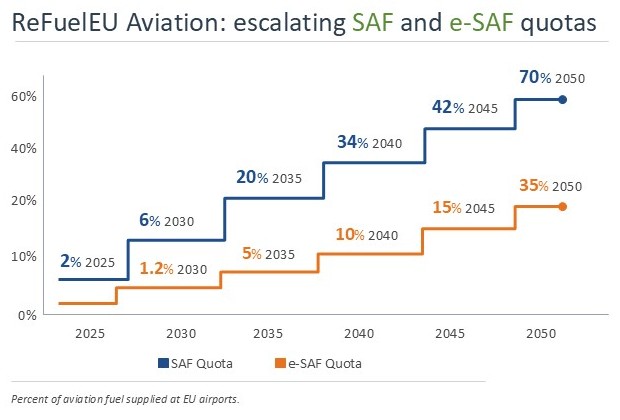
Required rates are set out in Annex I to the RFEUA:
- The core quota rises from 2% in 2025 to 70% in 2050.
- The synthetic sub-quota rises from an average 1.2% in 2030–2031 to 35% in 2050.
Aircraft operators have no direct SAF obligation. They must instead follow the “anti-tankering” rule and lift at least 90% of the fuel they require at each European Union airport, so that the SAF/eSAF quotas cannot be avoided by refuelling outside of the European Union.
This is not a regime that can be neutralised by writing a cheque. Unlike the UK mandate, RFEUA has no buyout. A shortfall triggers a fine, and the missing volume must still be supplied in the following year in addition to such year’s applicable quota.
The minimum fine is at least twice the relevant price gap multiplied by the noncompliant volume. Using the European Union Aviation Safety Agency’s (EASA) 2024 reference prices (2,085 euros per tonne for SAF vs 734 euros per tonne for conventional fuel), a 10,000-tonne shortfall would trigger a minimum fine of approximately €27 million.
Germany’s implementing legislation illustrates the severity. Section 37l of the Federal Immission Control Act (BImSchG) sets an obligation payment of 17,000 euros per tonne for synthetic aviation fuel shortfalls, with no cap linked to company size, revenue or ability to pay. Section 62a BImSchG separately classifies the failure to make good a shortfall under Article 4(7) of the RFEUA as an administrative offence carrying fines of up to €50,000.
There is temporary flexibility – but it is a runway, not an exit. Until end-2034, a supplier can satisfy the quotas as a weighted average across the European Union airports it serves, allowing well-supplied hubs to offset weaker locations. However, from 2035, this pooling ends, and each airport must independently meet the quota.
As explained in our recent briefing, the UK mandate takes a different approach. Suppliers unable to meet their obligation may buy out at prescribed rates – a mechanism the UK Government designed expressly to cap costs and prevent extreme price spikes.
Paying the buy-out price extinguishes the obligation, so there is no carry-forward of shortfalls. This makes the EU mechanism the stronger demand driver for investors but also the more politically exposed model.
Notably, in the EU any penalties for noncompliance are recovered by a Member State’s nominated competent authority to ensure that funds are allocated to supporting research and innovation projects in SAF, the production of or mechanisms allowing the price differences between SAF and conventional aviation fuels to be bridged. Conversely, in the UK such funds are collected as part of the UK Government’s general pool of taxation funds managed by the Treasury.
Investment Barriers: Why Capital Is Not Flowing Despite a Clear Mandate
The regulatory signal is strong enough to create demand but not strong enough to make supply finance itself. Structural barriers explain the gap.
Technology: eSAF as a “Project-On-Project Risk”
eSAF is not a single technology bet. It is a cascade of interdependent project stages, and each must individually satisfy regulatory requirements for the end product to have value:
- Renewable electricity. Must satisfy additionality rules (newly-built capacity, not displacing existing clean power), geographical correlation (same region) and temporal correlation (broadly same time as fuel production). Power from a grid that is already overwhelmingly renewable, or surplus renewable output that would otherwise be curtailed, can also qualify.
- Green hydrogen. Produced by electrolysis using that Renewable Fuels of Non-Biological Origin (RFNBO)-compliant electricity.
- CO₂ source. Direct-air-captured, biogenic and geological CO₂ qualify. Industrial CO₂ is currently permitted but phases out in 2036 if it comes from power stations and phases out fully in 2041. A project depending on an industrial point source needs a transition plan, not merely a present-day eligibility opinion.
- eSAF synthesis. Fischer-Tropsch or power-to-liquid process, not yet commercially proven at the 50–80 kilo tonne annual capacity scale that the RFEUA requires.
- Certification. Third-party certification under RED-recognised schemes, with chain-of-custody evidence reconcilable to the Union Database (an EU-wide digital tracking and traceability platform used by suppliers to report mandatory data on SAF). Misleading information on SAF origin has the same fine as missing the quota.
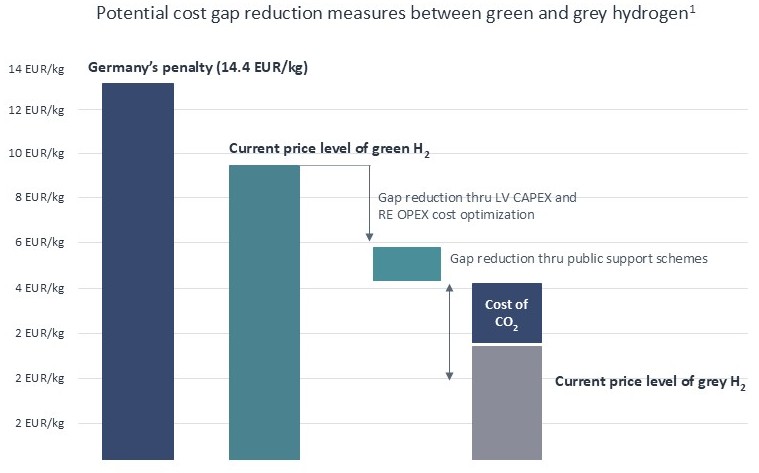
A loosening of the eligibility criteria, such as accepting any renewable electricity rather than only newly-built capacity, would materially ease this burden.
The scale compounds the problem: eSAF projects at commercial scale require capital expenditure (CapEx) in the €2-2.5 billion range. Without proven technology and contracted revenue, it’s too large for venture or early-stage capital, yet too risky for conventional infrastructure investors. The pool of investors capable and willing to take a first-of-a-kind technology risk at that ticket size is very narrow.
The Circular Flight Path: No Offtake Without FID, No FID Without Offtake
EASA’s second Annual Technical Report confirms the scale of the deadlock. None of the larger eSAF facilities in the EU have reached final investment decision (FID). Projections had fallen following cancellations and suspensions. However, several projects must commit by the end of 2026 if the 2030 synthetic sub-quota is to be met without imports or penalties.
The obligated fuel suppliers are the parties with the balance sheets and market access to sign long-term offtake agreements, but oil companies have been reluctant to do so. Their commercial incentive is to wait. Fossil fuel assets remain profitable, and every euro committed to eSAF offtake reduces returns on existing concessions. Without offtake, a developer cannot close project finance. Without FID, there is no product. Without product, the lobbyists’ argument writes itself: the product does not exist, so we cannot be penalised.
Airlines cannot easily break the deadlock. Their normal fuel-hedging horizon is roughly one to two years. A 10-year (or longer) commitment to a product costing eight to 10 times as much as kerosene would put a speculative, high-cost liability on the balance sheet through multiple demand shocks, recessions and fuel-price cycles.
The Challenge of Scaling SAF Supply
The 2025 market data confirms this is not a theoretical shortage, albeit there has been a significant uplift. In 2024, SAF comprised only 0.60% of fuel supplied to EU aviation. Fewer than 10 suppliers accounted for most deliveries across 33 airports, and 98% of feedstock came from used cooking oil or waste animal fats. Of that, 68% was imported (China 38%, Malaysia 12%). The existing supply base is concentrated, import-dependent and dominated by feedstocks that cannot scale indefinitely.
The recently released EASA data for 2025 records that 2.8% of fuel supplied was SAF (a sixfold increase), delivered to 121 airports across all 27 Member States. However, the import dependency has deepened: 85% was imported including 61% from China, 8% from Malaysia and 5% from Indonesia. The EU market’s reliance on import is significant. Should countries like China decide to impose their own SAF mandates, this could threaten supplier compliance with the EU mandate.
The EU’s answer is to put an intermediary between producer and buyer. The Sustainable Transport Investment Plan (STIP), announced in November 2025, deploys the H2Global mechanism for eSAF. The mechanism is designed to solve the precise mismatch that has stalled the market: long-term certainty for the producer, short-term flexibility for the buyer.
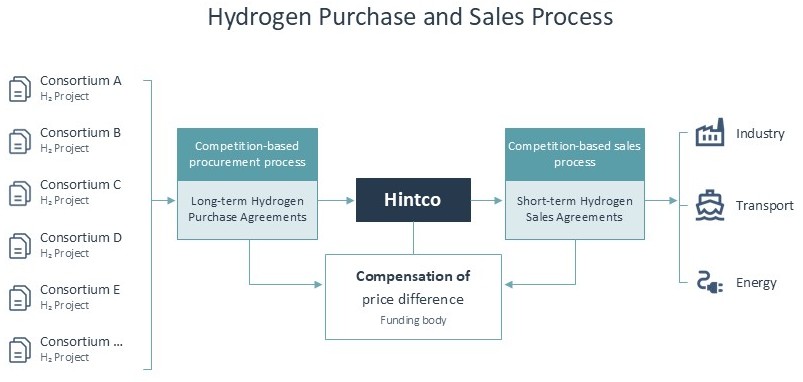
In mid-September 2026, the European Commission announced that Germany, Luxembourg and Austria will launch a pilot double-sided auction with over €2.1 billion in funding as part of the eSAF Early Movers Coalition. A pilot auction was attempted in 2022 deploying the H2Global model for eSAF. It ended with no bids for eSAF.
The UK addresses the same problem differently. Its Revenue Certainty Mechanism (RCM), modelled on the renewables CfD framework, offers SAF producers a guaranteed strike price backed by a government counterparty (expected to be the Low Carbon Contracts Company).
The producer carries demand risk. The counterparty carries price risk. The first contracts will be limited to non-HEFA SAF, with the legislative framework expected by end-2026, though strike price, floor price and contract length remain undetermined. Where the EU’s H2Global bridges the tenor mismatch between long-term producer needs and short-term buyer flexibility, the UK’s RCM targets price risk directly. Neither instrument is yet operational at the scale the market requires.
Regulatory Certainty: Does the RFEUA Framework Still Fit Reality?
RFEUA was adopted in October 2023 at the peak of the hydrogen enthusiasm, which has since cooled considerably. Since then, the macroeconomic environment has shifted materially. The Iran conflict and continued instability from the war in Ukraine have disrupted energy markets. Higher interest rates and persistent inflation raised construction, equipment and financing costs across the board, making projects considerably harder to finance. The CapEx assumptions underlying the regulation – and the support mechanisms designed around them – may no longer reflect what it actually costs to build and finance a commercial-scale eSAF facility.
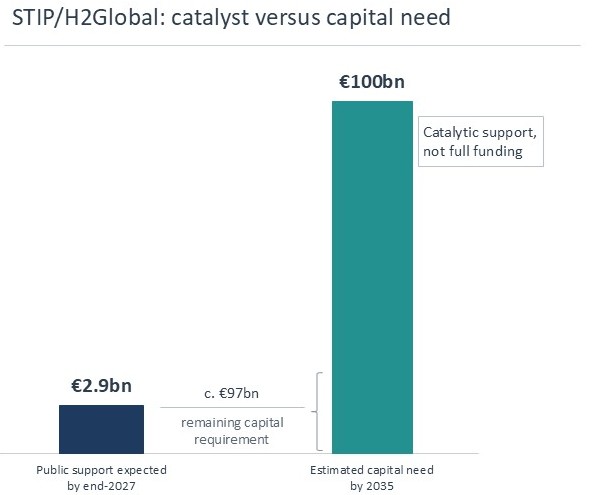
Projects currently being developed report CapEx in the €2–2.5 billion range. The available public support (Innovation Fund co-financing, Emissions Trading System (ETS) allowance reserve, Taxonomy inclusion) is helpful but modest relative to these sums. If the gap between regulatory expectation and economic reality widens further, it could undermine the investability the EU mandate was designed to create.
The 2027 Commission Review is the scheduled mechanism for recalibration. It may revise the scope of ReFuelEU, eligible fuels, minimum quotas, fine levels and support mechanisms. It may also introduce book-and-claim, which could improve liquidity and reduce airport-specific bottlenecks. But it cuts both ways: it is the natural vehicle for strengthening the framework but also a mechanism which could create more uncertainty and instability in the framework. The uncertainty could put a brake on investment in the run-up to the 2030 sub-quota.
There is no hardship clause in the EU framework. Germany’s implementing legislation contains no cap or mitigation for disproportionate economic impact. The EU has chosen maximum regulatory pressure – a notable contrast to the UK’s buyout ceiling, designed to prevent the compliance cost from becoming unsustainable. The consequence for investors is that the EU framework creates a stronger demand signal but carries a higher recalibration risk with the looming regulatory review.
What Investors Should Examine
Every eSAF investment requires careful examination of the entire value chain – from the RFNBO compliance of the electricity source to the durability of the CO₂ supply to the integrity of feedstock certification to the robustness of the offtake structure and the project’s resilience to regulatory change after the 2027 Commission Review. The interaction among quota compliance, ETS exposure, the SAF allowance reserve and available public co-financing should be modelled together rather than assessed in isolation.
For financial investors, the practical takeaway is to focus on projects with contracted or intermediary-backed revenue (e.g. through H2Global) and secured inputs across all stages instead of stand-alone positions in a single link of the chain.
Key flags to monitor include:
- offtake without long tenor or creditworthy counterparties;
- reliance on industrial CO₂ beyond the phase-out dates;
- unproven technology at commercial scale; exposure to the outcome of the 2027 Commission Review; and
- any signs of political softening of the quotas or fines.
Outlook: What Must Happen by 2030
The immediate catalyst is timing. Further H2Global eSAF auctions are expected in 2026 or 2027. Their design and award timetable will determine whether the first projects reach FID early enough to supply the 2030 sub-quota. A delayed auction compresses the construction, commissioning and certification runway to 2030.
The auction sits within a wider policy stack. Investors should track the ETS allowance reserve (20 million free allowances to 2030 to narrow the SAF–kerosene price gap), reform of the Energy Taxation Directive (proposed phase-out of the aviation kerosene tax exemption, with favourable rates for SAF; still under negotiation), the Flight Emissions Label (voluntary EU label showing passengers per-flight emissions, including SAF use), funding through Horizon Europe (R&D and pilot projects), the Innovation Fund (ETS-funded grants for first-of-a-kind commercial plants) and InvestEU (EU guarantees de-risking private finance), and the Renewable and Low-Carbon Fuels Value Chain Industrial Alliance (Commission-led platform building a project pipeline for aviation and maritime fuels).
As explained in our recent briefing, the closest precedent is the renewables market 20 years ago. It was nascent, high-cost and subsidy-dependent. But eSAF faces a steeper climb – higher CapEx, a more complex technology cascade, and a geopolitical environment that has raised both the urgency and the cost. The EU mandate supplies the demand signal. STIP and the first auctions must now supply the revenue certainty that turns that signal into financed capacity.
2027 Review Will Be the EU’s Decisive Moment
The 2027 review will test whether the EU can hold firm on a framework adopted before the current cost and geopolitical realities, or whether it introduces a safety valve of its own.
For investors, this is a bet that a binding, escalating mandate without a buyout, scarce ready-to-build capacity and intermediary mechanisms can convert today’s deadlock into tomorrow’s contracted infrastructure – provided the regulatory framework survives its first real stress test.
Connect with Orrick’s Global Oil & Gas team at [email protected] to discuss your next project, investment or strategic initiative.