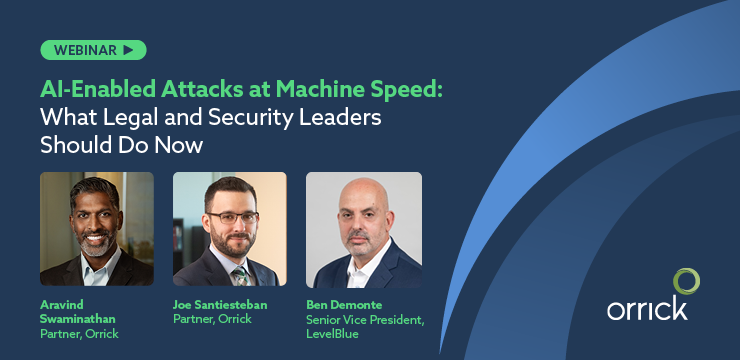
AI-Enabled Attacks at Machine Speed: What Legal and Security Leaders Should Do Now


3 videos | 10 minute read | November.23.2026

Summary

  • The AI-driven cybersecurity crisis is here. Instead of incidents that unfolded over weeks in the past, they are now taking place in hours.
  • Widespread multi-agent attacks have fundamentally altered the operational, legal and reputational risks faced by businesses.
  • Legal and Security leaders need a fresh framework for setting priorities, briefing boards and executives, and preparing for the decisions this new threat environment demands.

Key Takeaways

  1. Test your resilience to a system – and business – shutdown.

    Attackers using AI tools can now infiltrate and seize control of a company's environment within hours, and containment is more challenging than ever because hackers can re-take credentials faster than defenders can rotate them. Companies may then face a stark choice: Keep the business up, or shut systems down? Organizations that run mostly in the cloud – many of which have never faced this decision with traditional ransomware – may be confronting it for the first time. The next question is even harder: when, and how, can we bring it back?

    Challenge whether existing business continuity processes will work in this new threat landscape. Companies should build this reality into tabletop exercises with executives. Contrast attacker activity that unfolds in minutes with incident response that still takes hours, and walk through what the shutdown decision and restoration would actually involve. Part of that exercise should test whether outside help is ready to go – with incident response firms stretched thin, negotiating a forensic engagement mid-attack can take longer than the attack itself.

  2. Lock down credentials, including the ones you’re giving your own AI.

    Companies racing to innovate with AI have inadvertently built a target-rich environment for attackers. AI coding tools are leaving credentials scattered across code and pipelines, and teams are handing AI agents “god-like” privileges so they can do their jobs. The result: the rush to deploy agentic AI is undoing years of identity work, on a control layer that was already struggling. And attackers can now find and use those credentials at machine speed.

    That shifts the priority upstream: reduce what attackers can find in the first place. Hunt down stored credentials, move secrets into managed vaults, and lock down service and AI-agent accounts. Treat every agent deployment as an identity decision: What can it access? With whose privileges? How would we know if it were compromised?

  3. Respond as though all attacks are AI-enabled.

    A natural instinct is to scour an attack for signs it is AI-enabled: telltale strings in the logs, or activity moving faster than any human could. But those signs aren’t reliable, and threat actors are working to erase them. Some are deliberately slowing their own AI down to avoid triggering the volume-based indicators many alerting systems rely on. In one matter, captured prompts showed attackers using a client's own AI tools to locate areas without logging or endpoint detection, then building their own API in the environment to exfiltrate data at scale – in ways that may not trigger the object- or file-level logging companies have implemented in recent years.

    As with attribution, confirming AI involvement matters less than getting the incident under control. Treat every attack as AI-powered and respond at that pace from the start, rather than waiting to confirm AI involvement before adjusting.

  4. The "reasonable security" benchmark is moving – stay in the pack.

    The largest organizations have responded to AI-enabled threats by turning the same tools on their own systems, making massive investments in the race to find and fix vulnerabilities. One large financial institution reportedly hired a thousand contractors over the summer to fix vulnerabilities identified by AI tooling. That surge is part of why so many vulnerabilities are being published, and it is redefining what a reasonable, risk-based security program looks like.Regulators, too, are asking whether companies are using AI to harden their own defenses.

    Companies may not be able to match the largest institutions dollar for dollar, but in the aftermath of a breach, they will need to show they kept pace with their peers – for example, by running AI-assisted penetration testing against their own environments. And while patching will remain difficult, “patching is too hard, so we didn’t do it” will not hold up in litigation over whether a company had reasonable security. Companies need a documented, risk-based strategy that reflects today’s threat environment.

  5. To move the board to action, Legal and Security should make the case together – with risk judgment, not alarm.

    Meeting this new threat environment will take resources and hard decisions, and both require board and leadership buy-in. The threat is real, but alarm alone rarely moves the needle – a clear-eyed picture of the risk does. Here, Legal and Security have a critical role to play: they have always been the organization’s risk managers, and they are most persuasive together.

    While AI adoption carries risk, shutting down the use of AI tools can’t be the answer – employees will simply use their own, building a shadow IT infrastructure that no one can see or secure. So the message isn’t “don’t innovate” – it’s that every decision to innovate brings risk. Make two questions part of the executive team’s mantra: What is the risk if we do this? How are we addressing it? Together, Legal and Security can give management a framework for deciding which risks are acceptable and how best to mitigate them.

Frequently Asked Questions (FAQs)

  1. If we have to shut down systems during an attack, how do we know when we can bring them back online?
  2. How should we be finding and fixing our vulnerabilities?
  3. Do we really need a forensic firm on retainer before an incident happens?

Note: Videos require functional cookies to load.

1. If we have to shut down systems during an attack, how do we know when we can bring them back online?

  2 minute watch

Joe Santiesteban: The really important decisions: Do I keep the business up or not? Do I shut down systems? Do I not? Do I contain? Do I not? The attackers are getting to the place within two hours of compromising all of your infrastructure, and the question is, do you leave it up, or do you not? in that moment.

Aravind Swaminathan: Their ability to functionally DDoS you from the inside out, and say, we’ll stop if you pay me, is going to be the next wave of extortion that we’re going to see. This impacts the revenue of the business and its service to customers, and that’s the whole point. You have to know what you’re going to do if you’re forced into that corner.

Joe: This is a new reality that needs to be incorporated, or should be incorporated, into tabletop exercises. Put executives through the paces of having to confront this reality. This is our current incident response capability, it takes hours, and this is what the threat actor’s doing, it’s taking minutes. What is our response actually going to look like, and then how are we going to confront some of these really important decisions?

Aravind: Particularly the shutdown business continuity piece because we sometimes think it’s easy, we’ll just click a button and shut it off. And we had a client where we did a tabletop exercise, they’re like, yes, we have to shut it off. But then all the engineers are like, but I can’t just turn it back on. It doesn’t work that way. It’s not a light switch. It’s not like I just flip it, everything reboots, and we’re back online. We don’t know that it’ll ever come back online. And so there’s a real question of, if you shut it off, can you turn it back on? And that’s the kind of resilience we need to be testing. ^top

Joe Santiesteban co-leads Orrick's Cyber, Privacy & Data Innovation group. He is a trusted cybersecurity lawyer and strategic advisor who regularly steers clients through high-stakes cyber incidents, regulatory scrutiny and related litigation.

Aravind Swaminathan is co-head of Orrick’s technology sector and Chambers-ranked in Privacy & Data Security: Cybersecurity and Litigation. A former federal cybercrime prosecutor, he helps clients with defensive and responsive tactics against AI-enabled attacks.
2. How should we be finding and fixing our vulnerabilities?

  3 minute watch

Ben Demonte: In the past, when a vulnerability was identified, there were situations where, although the application was vulnerable, there was no known exploit. So, yes, you had to patch it, but because it wasn't being used in the wild, you know, you had some time. That's gone away. Every vulnerability now is immediately exploitable by the very nature of what the AI agent is doing, right? The AI agent is not creating vulnerabilities to help secure your system. They're creating vulnerabilities so that they can exploit. So they're not even finding all vulnerabilities, they're literally finding what can they exploit, right?

Aravind Swaminathan: We were able to capture some of the prompts; they used a client’s own AI tools to find out where there was not logging. Where there’s no EDR, where there’s no detection or monitoring, you build your own API, because you can literally vibe code it in the environment, and then you can exfiltrate data at a massive scale. They’ll find the hole faster and be able to just build it in real time, in your environment, and then they just don’t have a teeny pipe, they have a massive pipe.

Joe Santiesteban: I’ve been advising clients now to pretty much be doing some form of agentic pen testing. At least doing some version of multi-agent, AI-assisted pen testing on your environment because the attackers are using it. The other is, what we see consistently in these attacks is the attackers quickly are searching for credentials. It is all about how to expand the blast radius as soon as possible in the attack path. And we have seen, with the proliferation of AI-assisted coding tools, credentials that are being just left throughout environments, and attackers are just finding them very easily. So, rethinking about the way that we’re securing credentials.

Ben: So patching is always going to be a challenge, but I do think you have to create some strategy, right? I’m the non-lawyer here, but come litigation, and whether or not you had reasonable security, it can’t be, well, patching’s too hard, so we don’t do it. That’s not going to work, right? You just gotta create a strategy for your organization.

Joe: From a legal perspective, you don't want to be the gazelle with the broken leg, right? And so you want to stay, you know, in the pack. What does your version of that look like? ^top

Ben Demonte, Senior VP at LevelBlue, is a seasoned cybersecurity executive and senior digital forensic examiner with more than three decades of experience spanning federal law enforcement, global consulting leadership, and high-stakes incident response.

3. Do we really need a forensic firm on retainer before an incident happens?

  1 minute watch

Ben Demonte: Based on data that we've collected, we know that dwell time, prior to all this AI was about 31 days. So, attacker was in your network for about 31 days. We've seen now, in Q4, that go down to two hours. So, if you think about, your response and what your plan needs to be -- the plan needs to change, right?

Joe Santiesteban: It is almost impossible to find a forensic firm right now to come do an investigation with the speed and scale needed if you don't have an existing relationship or an existing retainer. You will find someone, but it can take a while.

Ben: Lots of organizations take 48 hours to redline contracts for their incident response vendor, right? Like, 48 hours, like, this is over in 48 hours. Like, the actor is come, gone, posted. Like, they're nowhere in sight after this, right?

Joe: It takes more time than you can have, right? And so the idea being that having that retainer in place now is more critical than it ever has been.  ^top

Watch the Full Conversation

Webinar: AI-Enabled Attacks at Machine Speed: What Legal and Security Leaders Should Do Now