EU AI Act — Transparency Obligations for AI-Generated Content (Article 50)
15 minute read | August.14.2026
Below, we map the transparency obligations applicable to AI-generated or manipulated content under Article 50 of the AI Act (Regulation (EU) 2024/1689). This covers Article 50(2) (provider obligations), Article 50(4) (deployer obligations) and Article 50(5) (horizontal requirements), cross-referencing the Commission Guidelines (20 July 2026) and the Code of Practice on Transparency of AI-Generated Content.
At the end are explanations of expectations in terms of compliance, and the “AI-generated” icons proposed by the European Commission.
This does not cover Article 50(1) (interactive AI systems), Article 50(3) (emotion recognition / biometric categorisation) or personal use exemptions.
Hierarchy of Sources
- The EU AI Act creates binding obligations.
- The European Commission Guidelines provide non-binding interpretive guidance.
- The Code of Practice structures a compliance demonstration pathway for signatories. Adherence does not constitute conclusive evidence of compliance and is voluntary.
Table of Contents
Part 1: Provider Obligations Article 50(1) for General Transparency Requirement
| Topic / Subtopic | EU AI Act (Law) | Guidelines (European Commission) | Code of Practice (CoP) |
| Statutory obligation (see also Recital 132) |
Providers must ensure that AI systems intended to interact directly with natural persons are designed and developed so that natural persons are informed that they are interacting with an AI system, unless this is obvious from the point of view of a natural person who is reasonably well-informed, observant and circumspect, taking into account the circumstances and the context of use. The purpose is to allow individuals to make informed decisions on outputs, to avoid overreliance on systems and to calibrate trust in the system outputs and interactions. |
Main components: (1) Providers (2) Of an AI system (3) System intended to interact directly with natural persons, (4) Unless subject to an exception. (§29) | The CoP does not address Article 50(1). |
| Exception (1) | It is (a) obvious (b) from the point of view of the reasonably well-informed, observant and circumspect natural person that they are interacting with an AI system. |
Guidance inverses the order of the EU AI Act. First, consider the individual, then “obviousness”. Provider has burden. Standard draws on EU consumer protection concept of “average consumer” and a two-step analysis: (1) The intended audience (2) How well informed a member of that audience is Relevant factors: §44 Should be interpreted restrictively. Examples: §45 |
|
| Exception (2) | The obligation does not apply to AI systems authorised by law to detect, prevent, investigate or prosecute criminal offences, subject to appropriate safeguards for the rights and freedoms of third parties, unless those systems are available for the public to report a criminal offence. |
“Authorised by law” refers to EU or EU Member State law. (§47) The purpose of the AI system must be to detect, prevent, investigate, or prosecute criminal offences (e.g., AI-undercover agent). |
|
| “AI system” | Per the definition at Article 3(1) of the Act, excludes simple non-AI generated responses., e.g., e-mail out of office. (§30) | ||
| “Intended to interact” |
Entails bidirectional exchange of information or actions with a genuine conversational or responsive character. Individuals should be able to provide input to the system, and the AI system should be capable of responding with outputs. It does not need to be initiated by a human. Passive collection or one-time collection of feedback is not covered. (§30) |
||
| “Direct” interaction |
Real-time or near real-time interaction. Excludes indirect or mediated interaction. Products and services that blend AI-generated responses with human-curated content should be disclosed as being AI-generated unless the outputs have been “properly” reviewed and sent by a human as the recipient’s main interlocutor. (§30) |
||
| “Natural person” | Out of scope: AI systems operating in closed physical environments, back-end machine-to-machine calls between AI systems, including AI agents, whose outputs do not reach individuals or virtual environments without any direct contact with individuals. (§30) | ||
| AI agents |
In scope of intended to interact with natural persons that instruct them or in the course of executing a task. AI agents must be designed and developed to disclose their artificial nature and the identity of the person on whose behalf they are acting (including when it is reasonably likely to interact with a human). Disclosures to be made for key steps such as authorization, reporting, validation, and at every new interaction. (§31) |
Part 2: Provider Obligations in Article 50(2)
A) General Requirements for All Content Types
| Topic / Subtopic | EU AI Act (Law) | Guidelines (European Commission) | Code of Practice (CoP) |
| Statutory obligation |
Providers of AI systems (including GPAI systems) generating synthetic audio, image, video or text1 must ensure outputs are:
|
Definitions:
|
|
|
Limitations (Exemptions are covered in Part 2C) |
Providers may take into account specificities and limitations of various types of content, the costs of implementation and the generally acknowledged state of the art. (Article 50(2)) |
Costs may be disproportionate to marginal gains. (§85) There may be narrowly defined cases where a technical solution based on less robust metadata markings is sufficient for compliance, e.g. when system is embedded in a controlled and closed environment. (§86) B2B applications where proportionality principle and limited benefits preclude application of the obligation. (§87) |
Commitment 3: Signatories commit to strive to achieve the best possible balance between effectiveness, interoperability, robustness and reliability of the marking and detection solutions as described in Measures 3.1 to 3.4. Operational constraints may impose limitations on computational time and resources, costs of implementation, as well as on scalability to very large or very small content. |
| Marking — Metadata | Recital 133 expressly refers to possible techniques including watermarks, metadata identifications, cryptographic methods for provenance and authenticity, logging methods, fingerprints or combinations of such techniques. |
Providers may rely on a single technique or combination, provided the overall solution is machine-readable and meets the four quality requirements. (§68) Techniques include watermarks, metadata, cryptographic methods, logging, fingerprints (Recital 133, §73). |
Mandatory: Digitally signed metadata, time-stamped in a secure, tamper-evident manner (Sub-measure 1.1.1). |
| Marking — Watermark | Guidelines §§72–73 identify watermarks as one possible machine-readable marking technique, alongside metadata, cryptographic provenance/authenticity methods, logging and fingerprints. | Mandatory: Imperceptible watermark embedded within the content (Sub-measure 1.1.2). | |
| Multilayer approach | Article 50(2), second sentence requires technical solutions to be effective, interoperable, robust and reliable as far as technically feasible, taking into account content-specific limitations, implementation costs and the generally acknowledged state of the art. |
Not prescribed by the Guidelines. Providers choose the technique(s) provided the overall solution meets Article 50(2) requirements. (§72) |
Under the current state of the art, at least two layers (metadata + watermark) mandatory for content disseminated online. Alternative techniques may be permitted in the future if proven equivalent (Measure 1.1). |
| Detection | Outputs must be detectable as AI-generated or manipulated (Art. 50(2), read with Article 50(5)). | Provider must make means of detection available; detection methods must produce human-readable results. (§§75-77) |
Detection solution available free of charge (limited exceptions for high-volume users of small providers). Results must be clear, comprehensible, indicating whether based on metadata, watermark, forensic detection or other (Measure 2.1, Measure 2.3). Sub-measure 2.1.3 requires detection solutions involving uploads to address privacy, confidentiality, data minimisation, security, limited retention or zero retention where applicable, and EU data protection compliance. Sub-measure 2.1.4 permits retirement of a detection solution only where replaced by an alternative with the same or better capabilities and backward compatibility. |
| Interoperability | Technical solutions must be interoperable (Article 50(2)). |
Refers to the capability of different technical solutions for marking and detection to operate seamlessly across multiple systems, actors, contexts and technical implementations. (§79) Providers must rely on publicly-available industry standard detection solutions to ensure full interoperability. (§76) Until such standards exist, providers may rely on their own, a third-party or a shared solution. Should be a time-limited situation. A provider that uses a third-party solution is responsible for ensuring its compliance with the Act. |
Interoperability solution for detection mechanisms by 2 February 2027 (Measure 3.4). |
| Effective, reliable and robust | Providers shall ensure their technical solutions are effective, interoperable, robust and reliable as far as this is technically feasible, taking into account the specificities and limitations of various types of content, the costs of implementation and the generally acknowledged state of the art, as may be reflected in relevant technical standards (Article 50(2)). |
Effective: Capability of solution to detect their marks and enable natural persons to identify AI-generated or manipulated content. Reliable: Capability of the solution to accurately identify and distinguish AI-generated or manipulated content from other content across a variety of content. Robust: Capability of solution to accurately identify and distinguish AI-generated or manipulated content from other content under varying conditions. (§79) |
Effective: –Considered effective when natural persons can access and understand the meaning of the detection results (Measure 3.1). Reliable: Assessment consists of two components: (i) how accurate the detection solution is regarding detecting the marking in nominal conditions where there is no alteration to the content, and (ii) how the accuracy of the marking and detection solutions varies with respect to the length, size, diversity, and semantics of the content (Measure 3.2). Robust: Solutions to maintain performance levels under varying conditions. Does not apply to AI systems subject to only to one lawyer of marking (Measure 3.3). |
| Optional measures |
Encouraged: Fingerprinting/logging (supplement only — Sub-measure 1.1.3). Encouraged: Richer provenance metadata (Measure 1.3). Encouraged: Perceptible marking functionality for deployers (Measure 1.4). |
B) Specific Content Category: Text (PDFs, Word, HTML)
- Containerised text (PDFs, Word, HTML) is treated as a distinct content category because it can carry metadata — unlike free-form text — which affects the marking regime applicable under the Code of Practice. The Guidelines define 'text' as discrete symbolic content composed of characters or numbers, capable of being read and interpreted semantically by humans (§56). The Code of Practice further distinguishes 'containerised text' as text embedded within a structured file format or a container, where the content is organised according to specific rules defined by the format — examples include text inside PDFs, Word documents or HTML files (CoP Glossary).
- Free-form text is defined by the Code of Practice as a raw sequence of characters with no enclosing structure, schema or container format — e.g. text shown on a website or within a chat (CoP Glossary). The Guidelines do not explicitly distinguish free-form text from containerised text. This operational distinction is introduced by the Code of Practice and affects the applicable marking regime.
- Very short text is text that is under 200 tokens.
| Topic / Subtopic | EU AI Act (Law) | Guidelines (European Commission) | Code of Practice (CoP) |
| (a) Containerised text | Same Article 50(2) standard |
Marking: Not prescribed. Providers may rely on a single technique or combination provided the four quality requirements are met. (§76) Detection: Providers must make means of detection available and ensure the detection result can be provided to natural persons in a clear and distinguishable manner. |
Marking: Under the current state of the art, two-layer approach (digitally-signed metadata and imperceptible watermark), consistent with audio/image/video. Contingent on state of the art. Alternatives permitted if proven equivalent (Measure 1.1). Detection: Solution requirements apply identically. Results must be clear, distinguishable and accessible (Measure 2.1, Measure 2.3). |
| (b) Free-form text | Same Article 50(2) and 50(5) standard | The Guidelines do not expressly distinguish free-form text from containerised text. That operational distinction is introduced by the CoP. |
Marking: Single layer only, imperceptible watermark (metadata not possible). For text greater than 200 tokens, watermarking is mandatory even if reliability is lower (Sub-measure 1.1.2). Detection: Access to detection mechanisms may be restricted to verified expert users (authorities, researchers, media, fact checkers) given lower reliability. Restriction limited in time until more reliable mechanisms emerge (Sub-measure 2.1.2). |
| Very short text | Article 50(2) does not explicitly exclude. | Not addressed by the Guidelines | Not watermarkable at the current state of the art. No watermarking obligation under the Code. Since no marking is applied, no detection result can be generated. Article 50(5) has no practical application at the provider level for this category (Glossary: 'Very short text'). |
C) Exemptions From Article 50(2) Transparency Requirements (That are Not Addressed in the CoP)
| Actions / Manipulations | EU AI Act (Law) | Guidelines (European Commission) | Examples from Guidelines |
| Assistive function for standard editing | Article 50(2) “This obligation shall not apply to the extent the AI systems perform an assistive editing function for standard editing” | Standard editing is the process of preparing existing content for publication without generating new content or changing meaning/style/intent. (§90) |
Examples may qualify as either editing or alternations. Guidelines do not clarify. (§92) Out of scope: Grammar correction and spellchecking, linguistic and minor polishing, formatting, format conversions, technical compression, noise reduction or removal for enhanced clarity, without changing meaning. Minor cropping, minor colour adjustments or corrections, lightening or darkening, sharpening for enhanced clarity or other standard editing and technical corrections, removal of dust spots, removal of red eye, deleting and obscuring backgrounds, pixelation or blurring of facts, rescaling a video clip, dynamic range compression and equalisation, limited video stabilization; standard adjustments to colour and contrast, minor adjustments to playback speed, noir corrections to level the horizon of an image, applying pixel filters to amplify parts of an image, applying colour maps, edge image completion, converting a black-and-white photo to colour and vice versa. Pixel filling for clarity, automatic transition clips. Medical image technical processing or reconstruction within medical devices. Transcription of conversations. In scope: AI-generated summaries of text; paraphrasing or rewriting text that changes style, structure and meaning beyond mere grammatical and minor stylistic correction. Removal, replacement or insertion of objects or persons in existing images and videos; facial replacement, modification. Synthesis of realistic speech in a specific person’s voice, generating realistic video depicting events that did not occur; altering body shape or skin colour, extreme lightening or darkening or contrast changes that change the meaning, intent and messaging. Creation of composite images or videos. |
| Non-substantial alteration | Article 50(2) “This obligation shall not apply to the extent the AI systems perform…do not substantially alter the input data provided by the deployer or the semantics thereof” |
Case-specific assessment. AI-assisted Augmentative and Alternative Communication (AAC)/customised neural voices that do not alter meaning are exempt. (§85-86) Not exempt: Translations, summaries, adding/removing objects, pixelation/blurring faces, altering body shape/skin colour, extreme colour adjustments, black-and-white conversion, composite images. (§91) |
|
| Law enforcement | Article 50(2) “Authorised by law to detect, prevent, investigate or prosecute criminal offences” | Must be authorised by Union or Member State law to detect, prevent, investigate or prosecute criminal offences, subject to safeguards (refers back to §§46-48). |
Part 3: Deployer Obligations Article 50(4)
This section covers the disclosure obligations applicable to deployers under Article 50(4) AI Act.
A “deployer” is defined under Article 3(4) AI Act as any natural or legal person, public authority, agency or other body using an AI system under its authority, except where the AI system is used in the course of a personal non-professional activity. The Guidelines clarify that “authority” should be understood as “assuming responsibility over the decision to deploy the system and over the manner of the actual use of the system (including its outputs). Technical control is not required. (§12)
A) Deep Fakes (Image, Audio, Video)
This section addresses the deployer's obligation to disclose AI-generated or manipulated content that constitutes a “deep fake” — i.e., image, audio or video content (text is not covered by the deep fake definition) that appreciably resembles existing persons, objects, places, entities or events and would falsely appear to a person to be authentic or truthful (Article 3(60) AI Act).
| Topic / Subtopic | EU AI Act (Law) | Guidelines (European Commission) | Code of Practice (CoP) |
| Statutory obligation |
Deployers of AI systems that generate or manipulate image, audio or video content constituting a deep fake must disclose that the content has been artificially generated or manipulated (Article 50(4), subparagraph 1). Exception: Use authorised by law for criminal
offense detection/ |
Guidelines (§112) identify cumulative conditions: An AI system; use by deployers for professional purposes; generation/manipulation of image, audio or video content constituting a deep fake; and no applicable law-enforcement exception. | Section 2, Commitment 1 mirrors the disclosure obligation for deep fakes and published text and commits signatories to implement disclosure through the EU icon or an equivalent compliant icon/label. |
| Definition of "deep fake" | Article 3(60): AI-generated or manipulated image, audio or video content that resembles existing persons, objects, places, entities or events and would falsely appear to a person to be authentic or truthful. |
Four cumulative conditions: (i) AI-generated/manipulated image, audio or video (not text) (ii) Appreciable resemblance to existing subjects (iii) 'Existing' means realistic, (unrealistic content excluded) (iv) Would falsely appear authentic or truthful — assessed considering diverse audience composition (children, elderly, lower digital literacy), not an 'average person' test. The assessment is holistic and context driven. AI-supported manipulation of insignificant substantive or technical aspects of pre-existing content may be of minor relevance for a person’s assessment of the authenticity or truthfulness of the content. (§§113-116) |
|
| Content that is not “deep fake” and is a “deep fake” | Examples of what will not be a “deep fake” and what is a “deep fake”: (§116) | ||
| Disclosure — Visual |
Article 50(4), subparagraph 1, read with Article 50(5). Deployers must disclose that image or video deep fake content has been artificially generated or manipulated, in a clear and distinguishable manner at the latest at the time of first exposure. |
Must be understandable/perceivable without technical tools or dedicated actions. At the start of a video, when encountering image while scrolling, etc. End credits alone do not comply with Article 50(5). For live/varied-timing content, also at later stages or persistently. (§§110, 132) |
Mandatory:
|
| Disclosure — Audio-only |
Article 50(4), subparagraph 1, read with Article 50(5). Same disclosure standard applies to audio deep fakes. 2 |
Guidelines (§110) clarify that deep fake disclosure should be understandable and perceivable by natural persons, including through visible or audible labels, without requiring technical tools or dedicated actions. |
Mandatory: Short audible disclaimer in plain language at the beginning. For long-form/live audio: Reminders at regular intervals and after interruptions. Where screen is available: additional visual disclosure (Sub-measure 1.2.3). |
| Optional measures |
Encouraged: Interactive second layer ('generated' vs. 'modified'). Alternative audible disclosures (earcons) pending EU-wide audio solution, with awareness-raising measures. |
2 For detailed practical guidance on how to implement disclosure requirements (visual, audio-only, published text, artistic works), see the section « How to Comply with Disclosure Requirements » below.
B) Exemptions From Deep Fakes Transparency Obligation
| Type of Content Generated | EU AI Act (Law) | Draft Guidelines (European Commission) | Code of Practice (CoP) |
| Artistic, creative, satirical, fictional or analogous works |
Article 50(4), subparagraph 1. The transparency obligation is not removed but limited to disclosure of the existence of such generated or manipulated content in an appropriate manner that does not hamper the display or enjoyment of the work. |
Content must evidently fall within one of five categories — ambiguous content does not qualify. Will be subject to strict interpretation; relevant factors considered are listed. (§122) Disclosure is still required even if the deep fake is evidently part of an artistic, creative, etc. work (§123) and Recital 134. What is appropriate disclosure is a case-by-base assessment. Deployers must ensure appropriate safeguards for third-party rights (IP, data protection, personality rights, freedom of expression). (§124), Recital 134. Categories:
Examples of deep fakes that do and do not qualify as creative/satirical/fictional or analogous works: §124 |
Icon/label placed appropriately to the type of work. At the latest at first exposure (e.g., accompanying notes, beginning/end credits — but end credits alone insufficient). For digital/interactive: Icon may be adjacent to frame or in UI elements if perceivable without dedicated actions. For non-digital (exhibitions, galleries, cinemas): At point of entry, accompanying materials, physical carriers (Commitment 3). |
| Law enforcement |
Article 50(4), subparagraph 1. Full exemption where use authorised by law for criminal offence
detection/ |
Full exemption including from Article 50(5) information requirement. (§125) |
C) AI-Generated or Manipulated Published Text
| Topic / Subtopic | EU AI Act (Law) | Draft Guidelines (European Commission) | Code of Practice (CoP) |
| Statutory obligation |
Article 50(4), subparagraph 2. Deployers of AI systems that generate or manipulate text published with the purpose of informing the public on matters of public interest must disclose the artificial origin. Exceptions: (i) human review/editorial control + editorial responsibility (ii) law enforcement. |
Guidelines (§130) identify cumulative conditions: An AI system; use to generate or manipulate text published to inform the public on matters of public interest; and no applicable exception for human review/editorial responsibility or law enforcement. | Section 2, Commitment 1 covers AI-generated or manipulated published text and commits signatories to consistent and effective disclosure of its artificial origin. |
| Scope — Published |
Accessible by an indeterminate, fairly large number of unrelated potential readers simultaneously/successively, whether paid or free. Text that is not published: Private correspondence, organisation-internal documents, messages in small, closed groups. (§131) |
||
| Scope — Informing the public |
Text must intend to communicate knowledge, opinions or facts. Text with an entirely different objective (e.g. entertainment) is not in scope. (§131) |
||
| Scope — Public interest |
Matters relevant to society at large, meriting public debate or scrutiny: public administration, fundamental rights, public health, environmental protection, consumer safety, democratic processes, public security, financial developments, economic/political/scientific/cultural developments with important public implications. (§131) In scope: AI news summaries on websites; AI-manipulated academic papers; AI-manipulated corporate investor reports; AI weather warnings on social media. Out of scope: AI novels/poems; AI advertising text (provided the advertisement is not published with the purpose of informing the public on matters of public interest — e.g., containing claims related to health, consumer safety, sustainability or other matters of public interest; chatbot news summary available only to the individual user; text manipulated by a professional for client advice regarding required regulatory compliance measures. (§123) |
||
| Disclosure requirements for AI-generated or manipulated text |
Article 50(4), subparagraph 2 requires deployers to disclose that qualifying published text has been artificially generated or manipulated. Article 50(5) sets the clear, distinguishable, first-exposure and accessibility requirements. |
Must be perceivable through visible or audible measures, without technical tools or dedicated actions. At the start of the publication (not buried at the end). Applicable accessibility requirements must be met. (§132) |
EU icon or equivalent label above/at the top of the text, near the headline, or in the colophon — clear, consistent and distinguishable. For short text where labelling would degrade readability: Contextual notice in UI e.g., adjacent indicator or disclosure at beginning of exposure session (Sub-measure 1.2.2(f)). |
D) Published Text Exception for Human Review, Editorial Control and Editorial Responsibility
| Topic / Subtopic | EU AI Act (Law) | Draft Guidelines (European Commission) | Code of Practice (CoP) |
| Condition 1: Human review or editorial control | Article 50(4), subparagraph 2 |
Deliberate substantive examination by competent natural person(s); or control by an editorial entity with authority to approve, alter or reject based on substance (including fact checking, a minimum requirement). Superficial, purely formal or procedural checks (spell checking, grammar correction, automated review processes) do not suffice. (§§134-137) Substantive AI intervention occurring after human review can cause the exception to be voided. |
|
| Condition 2: Editorial responsibility | Article 50(4), subparagraph 2 |
A natural or legal person must hold ultimate legal responsibility over the publication. Identity of the natural person and thecontact information must be publicly available. (§138) |
|
| Effect of the exception |
Article 50(4) disclosure obligation does not arise. Article 50(5) requirements for deployer labelling do not apply. The provider's Article 50(2)/(5) obligations continue to apply to the system. (§§125-128) Examples: §138 |
Media service providers under Article 2(2) of Regulation (EU) 2024/1083 may rely on existing procedures. All other deployers must establish/maintain policies including identification of the person with editorial responsibility and organisational measures. Contact details of the person/function with editorial responsibility must be published (Commitment 4). |
Part 4: Article 50(5) Horizontal Transparency Obligations for Providers and Deployers
This section addresses the overarching presentation requirements that apply across all transparency obligations in Article 50(1)–(4).
| Topic / Subtopic | EU AI Act (Law) | Guidelines (European Commission) | Code of Practice (CoP) |
| Statutory text |
Article 50(5). Information referred to in paragraphs 1–4 shall be provided to natural persons concerned in a: (i) clear and (ii) distinguishable manner at (iii) the latest at the time of the first interaction or exposure. The information shall conform to applicable (iv) accessibility requirements. |
||
| (i) Clear | Noticeable and easy to understand by the person concerned, including persons with accessibility needs. (§142) | ||
| (ii) Distinguishable | Easy to identify as separate from other information and the environment. Must be understood by the audience, including children. Not satisfied if only in a manual or hidden under menu layers. (§142) | ||
| (iii) First interaction or exposure |
Applies to each output with respect to any natural person exposed. Providers/deployers may inform earlier. For content encountered at different times (e.g. live broadcasts), disclosure should also occur at later stages or persistently. (§143) |
||
| (iv) Accessibility | Must conform to applicable accessibility requirements. No distinct or additional requirements imposed in Article 50 beyond those already applicable. | Accessibility must comply with applicable European Union law, in particular Directive (EU) 2019/882 (the European Accessibility Act) and Directive (EU) 2016/2102 (the Web Accessibility Directive). (§133) | ETSI EN 301 549 and WCAG 2.1 Level AA are recommended reference standards where the provider’s/deployer’s services or products fall within the scope of those requirements (Measure 1.1, Section 2). |
| Natural persons concerned | Throughout Article 50 | The person interacting directly with the AI system, active or passive users and other persons exposed to the AI-generated or manipulated synthetic content, with or without direct interaction with the AI system, and persons subject to the use of emotion recognition systems for the purposes of Article 50(3). (§141) | Term is used in the CoP but not elaborated. |
For Deployers: How to Comply with Disclosure Requirements (Article 50(4) and Article 50(5) AI Act)
This section consolidates the practical requirements for deployers to comply with their disclosure obligations. See Annex for EU recommended icons.
A) What Is Needed to Comply
General standards (Article 50(5):
-
Disclosures must be clear, distinguishable and accessible
-
Provided at the latest at the time of first exposure
-
Must conform to applicable accessibility requirements (Directives 2019/882, 2016/2102)
-
Must not require technical tools or dedicated actions from natural persons
For visual “deep fakes” (CoP Section 2, Commitment 1, Sub-measures 1.2.1–1.2.2):
-
Use the EU icon ("AI GENERATED" or "AI MODIFIED") or an equivalent label
-
Place with no intervening overlay, ensuring immediate recognition
-
For video: At the beginning, after interruptions and at regular intervals
-
Directly embedded or equivalent overlay
-
Accessibility: Audio descriptions, tactile/haptic cues, high contrast, screen reader compatible
For audio-only deep fakes (CoP Sub-measure 1.2.3):
-
Short audible disclaimer in plain language at the beginning
-
Reminders at regular intervals for long-form/live content, at minimum after interruptions
-
Additional visual disclosure where a screen is available
For published text (CoP Sub-measure 1.2.2(f)):
-
EU icon or equivalent label above/at the top of the text, near the headline, or in the colophon
-
For short text (single words or brief phrases): Contextual notice in UI is acceptable
For artistic, creative, satirical, fictional or analogous works (CoP Commitment 3):
-
Disclosure in a manner that does not hamper display or enjoyment
-
Icon placed appropriately to the type of work
-
For digital/interactive: May be adjacent to frame or in UI elements
-
For non-digital (exhibitions, galleries, cinemas): At point of entry, accompanying materials, physical carriers
B) What Does NOT Comply With Article 50(5)
-
Disclosure only in end credits
-
Disclosure only in terms and conditions or hidden in menu layers
-
Disclosure requiring users to perform dedicated actions or use technical tools
C) Legal Disclaimer on EU Icons
-
The use of the EU icons is optional, but the labelling requirements under Article 50 AI Act are not.
-
Use of the icons does not establish legal compliance by itself. Deployers remain responsible for ensuring that any disclosure meets the requirements of Article 50 AI Act.
Annex For Deployers: EU Disclosure Icons (Code of Practice, Annex 1)
The Code of Practice provides three publicly-available EU icons developed by the AI Office for deployers to comply with their disclosure obligation under Article 50(4) and Article 50(5) AI Act.
These icons are free to use without attribution to the European Commission or the AI Office.
Figure 1 — “AI GENERATED”
When the entire deep fake content (image, audio, video) or text is fully generated by AI with no human-created elements or human editorial control (apart from prompting):

Figure 1. The EU icon developed by the AI Office for fully AI-generated content in several variations against a background (black, white, black transparent, white transparent).
Figure 2 — “AI MODIFIED”
When pre-existing, human-made content was partially modified with AI turning it into a deep fake or text on matters of public interest:

Figure 2. The EU icon developed by the AI Office for partially AI-modified content in several variations against a background (black, white, black transparent, white transparent).
Figure 3 — Basis “AI icon”
When AI was involved in the creation of deep fake content (image, audio, video) or published text or when a custom label or interactive second layer is implemented:
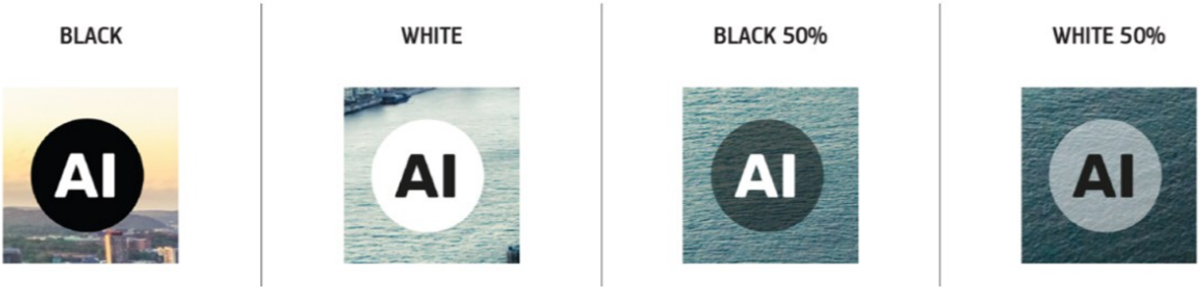
Figure 3. The basic EU icon developed by the AI Office for partially AI-modified content in several variations against a background (black, white, black transparent, white transparent).
Legal disclaimer (Source: EU AI Office website): The use of these EU icons is optional, but the labelling requirements under Article 50 AI Act are not. Use of the icons does not establish legal compliance by itself. Deployers remain responsible for ensuring that any disclosure meets the requirements of Article 50 AI Act.
Notes:
-
Icons have been empirically user tested across several Member States (noticeability, recognition, understandability, trust). Variants with explicit textual labels (“generated” / ”modified”) performed significantly better in clarity.
-
An audio-only EU icon will be developed by the Task Force.
-
A future interactive second layer is planned to enrich the icons with provenance data.