OLNS German Unicorn Census 2026 Part I:
Who Leads the Herd? – Company Characteristics and Founder Profiles
Orrick Legal Ninja Snapshots
19 minute read | November.25.2026
From Fairy Tale Creatures to Herd Animals
Once upon a time, not so long ago, a start-up worth USD 1 billion or more was the kind of thing you would only find in fairy tales. Hence the name: a unicorn. The term was coined back in 2013 by U.S. investor Aileen Lee, who told TechCrunch: "We wanted the term to feel special; because it's rare, almost magical to build a unicorn company". Rare and magical? According to PitchBook, more than 1,700 unicorns were roaming the world as of mid-2026. So, this once rare fairy-tale creature has become increasingly common – not exactly an endangered species anymore.
Fun fact: with 1,700 members, the unicorn herd is much more populous than the rarest horse breed in the world, arguably the Galiceño from Mexico, with a current estimated number of fewer than 100 (you are welcome for that trivia break).
In Germany, the herd is somewhat more manageable. We have found 40 unicorns as of early October 2026. However, this group has grown quite a bit in recent years as well. According to the German Startup Monitor 2026 (Deutscher Startup Monitor 2026) issued by the German Startup Association (Startup-Verband), ten start-ups have crossed the USD 1 billion valuation mark this year alone (as of October, and the year might still see the birth of a few more). We haven't seen such an increase since 2021.
We wanted to know: Who are the founders behind Germany's unicorns? How many of them teamed up, where did they come from, and is there such a thing as the typical German unicorn founder (spoiler: it's complicated)? In addition, we wanted to know how unicorn founders approached the questions around founder equity split and how these initial shareholdings developed over time.
This Legal Ninja Snapshot Series
In this two-part mini-series, we present our key findings:
-
Part I gives an introduction to our study and a brief overview of the unicorn history, followed by the company characteristics and founder profiles of Germany's unicorns in our data set:
- A. Unicorn Herd in Germany and Our Data Set
- B. Company Characteristics
- C. Founder Profiles
-
Part II provides deeper insights into founder team sizes, equity splits and continuous founder involvement in the company's management:
- D. Team Sizes and Equity Splits
- E. Staying Power: Bye Bye Baby
- F. Wrapping Up: Who Leads the Herd?
…and Much More in OLNS#15
For comprehensive background information on founder teams, team sizes and equity splits in German start-ups, we refer you to our OLNS#15 – Founder Teams in German Start-ups, where we analyzed more than 2,100 German start-ups incorporated between 2019 and 2024 with a focus on start-ups that received external funding. You will find this and other guides here: The Orrick Legal Ninja Series (OLNS).
At the end of this Snapshot you will also find a link to the entire OLNS German Unicorn Founder Census 2026.
Let's dive in.
A. Unicorn Herd in Germany and Our Data Set
To set the scene, we briefly trace how the German unicorn herd has grown over the past ten years.
According to the German Startup Monitor 2026, in 2016, only four German start-ups qualified as unicorns. While data quality is limited, it is fair to assume that the total unicorn herd worldwide at that time was in the low three-digit numbers.
And who was Germany's very first unicorn? That is surprisingly hard to pin down (much like the original fairy-tale creature). Zalando and Rocket Internet were unicorns before their 2014 IPOs, followed by Delivery Hero and Auto1. Who led the German herd first might forever remain a mystery…
In the years that followed, the German herd grew slowly but steadily, before the funding boom of the pandemic years changed the picture entirely. The turning point came in 2021, when 22 new German unicorns joined the herd in a single year. The herd peaked at 34 German unicorns in 2023 and shrank to 28 by the end of 2024, as some members lost their horn in down rounds or less glamorous exits.
Since then, things have looked rather rosy for our German unicorns, with the herd growing back to (at least) 40. Among them are even three decacorns – that's what the new rare species of start-ups with a valuation above USD 10 billion is called.
Back to the present and our current findings. Since there is no official unicorn list, you might arrive at a different count than our 40. We started with the German Startup Monitor 2026, cross-checked its findings against a few other public sources and then selected our unicorns based on the following criteria:
- Alive and not yet exited: We only looked at unicorns that are still active and privately held by the founders and their investors. Once a unicorn goes public, is acquired, or loses its unicorn valuation, it leaves the herd for our purposes (we will come back to those left out another time, so stay tuned); and
- German unicorns: We only included unicorns founded and operationally built up in Germany, regardless of whether or not the holding company or headquarters later moved abroad (e.g., through a flip).
Before we go any further, a few qualifications and a brief legal jargon guide (we are lawyers after all, and disclaimers are our love language):
- Cut-off date: Our analysis reflects the situation as of early October 2026, which allowed us to include a few recent additions to the herd, but more might join during the remainder of 2026.
- Founder and shareholder information: Reliable information on German unicorn shareholder structure is only publicly available for companies (initially) organized as a limited liability company (GmbH) or entrepreneurial company with limited liability (UG (haftungsbeschränkt)), as their shareholders' lists are filed with the commercial register (Handelsregister). Even then, the shareholders' list may not always reflect the full picture of legal and economic ownership, as, for example, trust arrangements (Treuhandverhältnisse) do not show up on it. Things also get murkier for German unicorns with a foreign holding company, or which are (initially or at some point during their growth phase) (re-)organized as a German stock corporation (AG) or a European stock corporation (SE). Their founder line-up and shareholdings are much harder to trace. In these cases, we had to rely on how the founders describe themselves and their start-up's shareholder structure on LinkedIn, in company press releases and other public sources (and we took them at their word).
- Who counts as a founder: For companies organized as GmbH or UG (haftungsbeschränkt), we generally counted those individuals as founders who held shares, directly or through a holding company, at or shortly after incorporation, in line with the approach of our broader German founder study published in OLNS#15. Where this information was not available, in particular for companies organized as AG or SE, we relied on how the founders are publicly described. Where a company was incorporated years before it adopted its current business, we followed the founding story as publicly told.
- No claim to completeness: Our data set might miss some German scale-ups that secretly have unicorn status. It might also include some that would no longer qualify if they raised a round today. In some instances, the last external funding round occurred a few years ago and in a rather different funding environment, so we cannot be sure the valuation still holds true.
- Small numbers: Our statistically minded readers will have noticed that 40 unicorns make for a rather small data set. Our findings, and in particular any comparison with the broader start-up ecosystem, should therefore be taken with a grain of salt. They show patterns, not proof.
Enough with the fine print. Now, on to the founders.
B. Company Characteristics
I. Unicorn Sectors
So, what do German unicorns actually do? Fintech and enterprise software/SaaS lead with eight companies each, together accounting for 40 % of our data set. Energy/climate and mobility/travel/logistics follow with five companies each (together 24 %), while four companies (10 %) have AI at the core of their business (we know that "AI" is a vertical that lacks definition in places, and we sorted companies in both the infrastructure and the application layer into this cohort). And then there is defense: three of our unicorns (8 %) are defense tech companies – as many as in robotics. The remaining companies are spread across various other sectors.
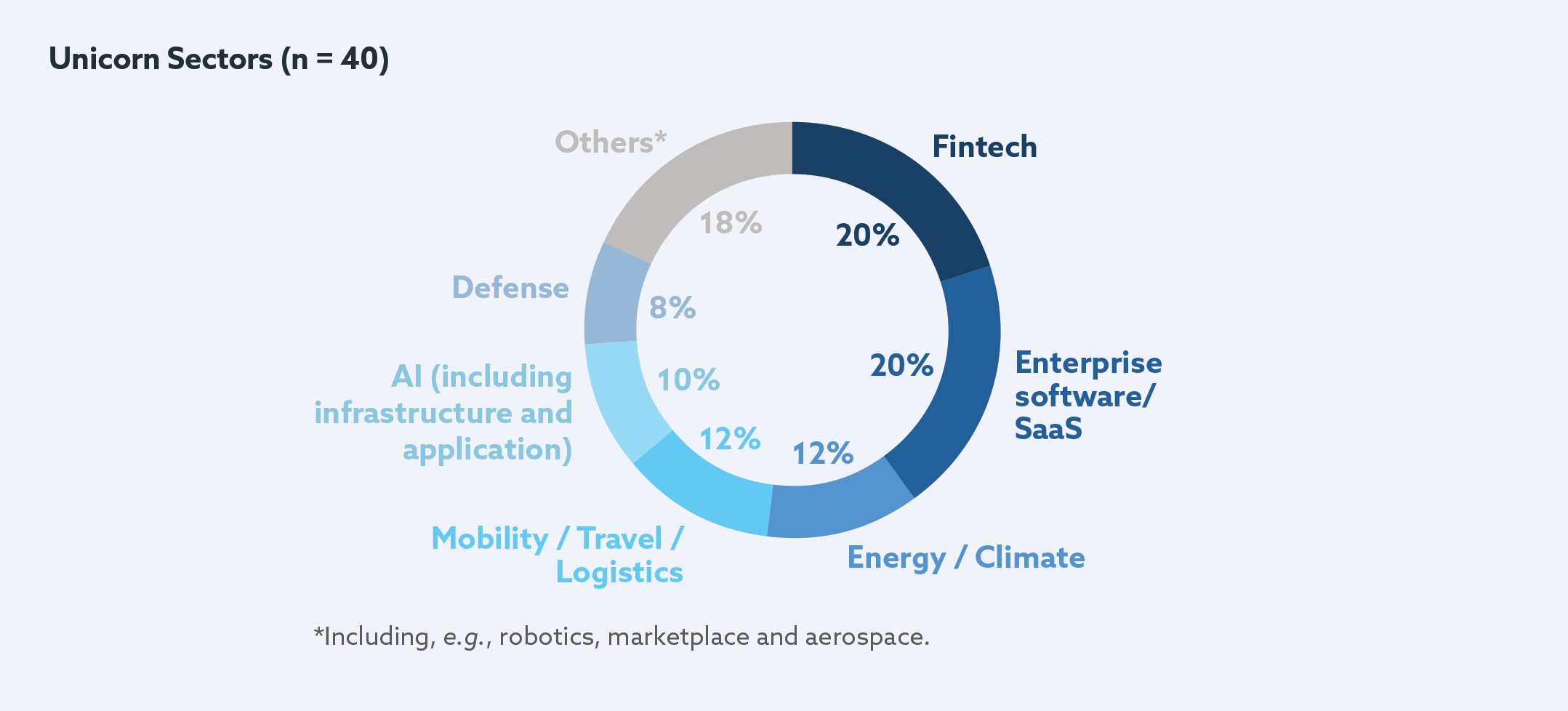
Not long ago, defense was a sector many VCs would not touch with a ten-foot pole. In fact, among the more than 2,100 start-ups incorporated between 2019 and 2024 that we analyzed in our OLNS#15 data set, defense start-ups were so few that they did not form a meaningful category of their own. Software, on the other hand, is the common denominator of both data sets, accounting for around 46 % of all start-ups in our OLNS#15 study. Energy/climate plays a much bigger role among our unicorns (12 %) than among the start-ups in OLNS#15 (only around 2 %), while healthcare, the third-largest sector there (around 13 %), has not (yet) produced a German unicorn in our data set.
II. Legal Form: Born as GmbH
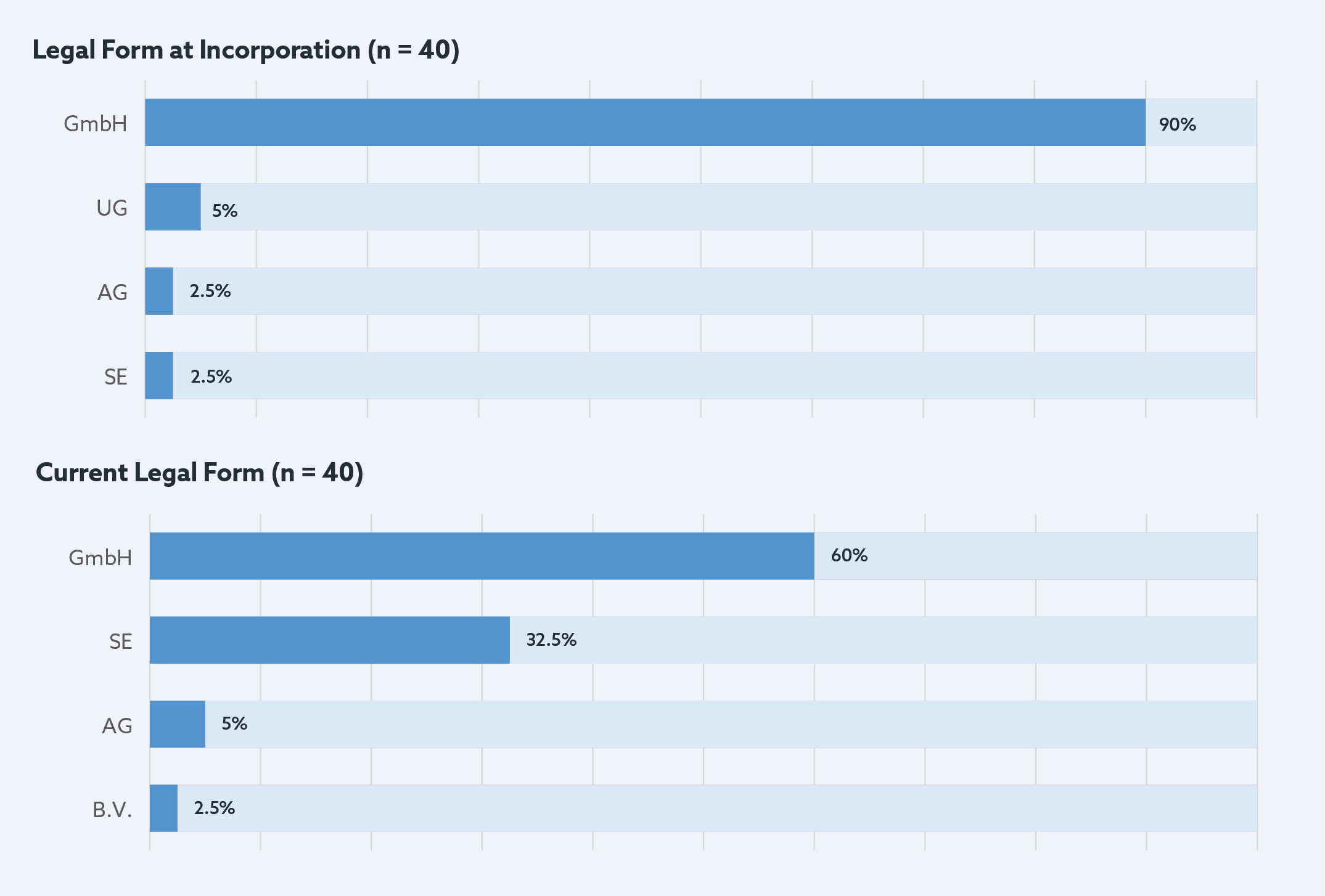
At founding, German unicorns look much like any other German start-up: 36 of our 40 companies (90 %) started out as GmbH, two as UG (haftungsbeschränkt), one as AG and one as (shelf) SE. No surprises here: the GmbH remains the go-to legal form for German founders. Unicorns, however, do change along the way. Twelve companies (30 %), including the two former UGs, later reorganized as an SE, on average about 8.5 years after incorporation. A single company took the AG route, converting from a GmbH 11 years after incorporation.
As a result, today's picture looks noticeably different: 24 German unicorns (60 %) are still organized as GmbH, 13 as SE (32.5 %, including the two former UGs), two as AG (5 %) and one in a foreign legal form (a Besloten vennootschap met beperkte aansprakelijkheid (B.V.) – the Dutch equivalent of the German GmbH). Clearly, the SE is more and more the legal form of choice for German scale-ups once they outgrow their GmbH shoes.
III. A Unicorn's Seat: Berlin Leads, Munich Catches Up
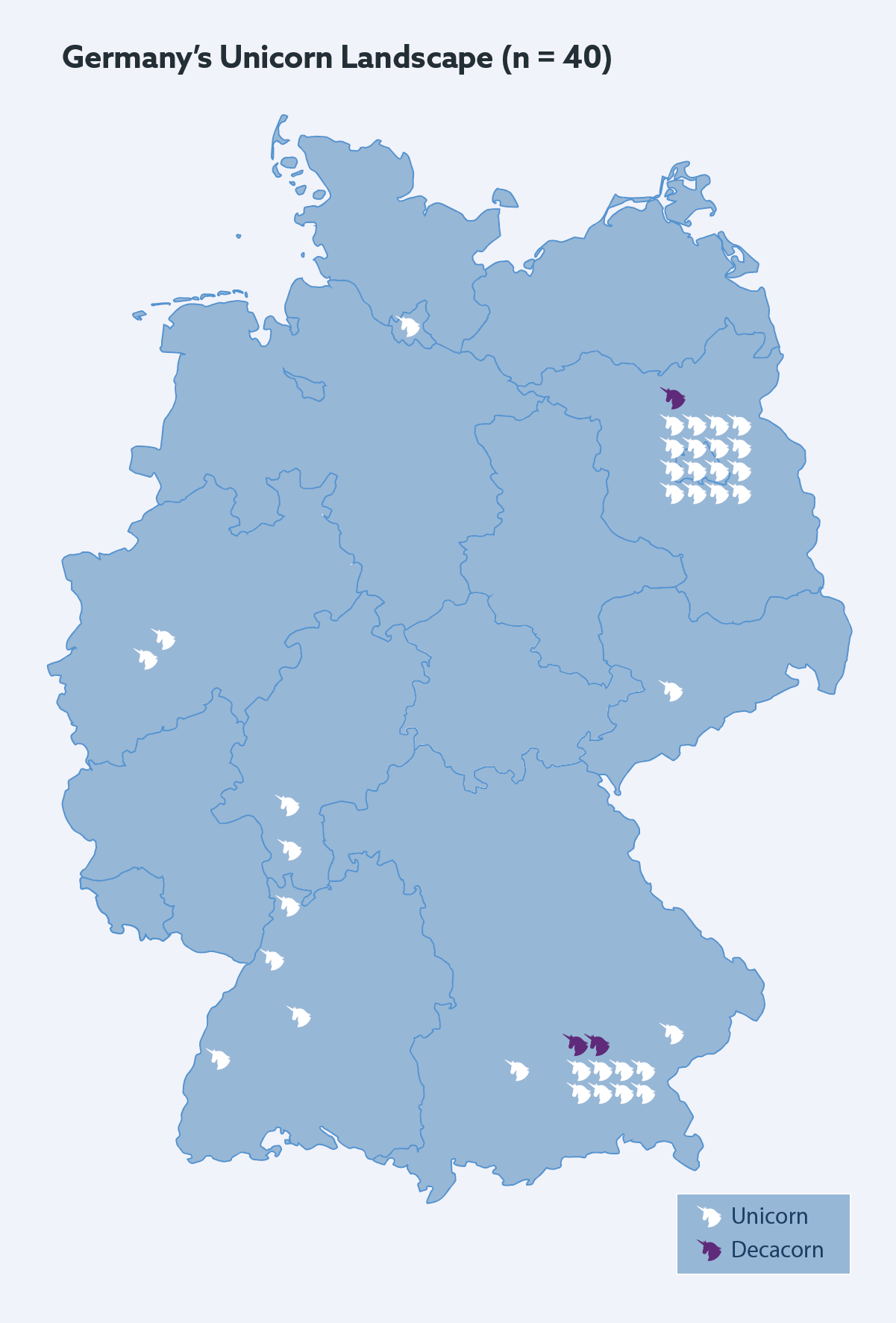
When it comes to location, the German unicorn landscape is a two-horse race. With 17 companies (42.5 %), Berlin is home to the largest share of German unicorns, followed by Munich with ten companies (25 %). Together, the two hotspots account for more than two-thirds of all German unicorns. But the momentum has shifted: in recent years, Munich has produced unicorns at a faster pace than Berlin. The remaining 13 companies are spread across the country, from Chemnitz, Hamburg and Cologne all the way down to lovely Freiburg im Breisgau.
IV. A Unicorn's Age: Good Things Take Time
Our herd is also older than one might think. Its oldest member was incorporated (incorporated meaning the date of their first articles of association) in 2005, its youngest in 2024, and the median year of incorporation is 2016. Five companies (12.5 %) were incorporated before 2010, while 16 (40 %) were incorporated in 2018 or later. The peak years were 2014, 2018 and 2021, with four future unicorns incorporated in each. A word of caution: the date of incorporation does not always match the "founding story". Some companies were incorporated years before they adopted their current name and business, while others took over a shelf company (Vorratsgesellschaft). For this Snapshot, we did not systematically compare each company's year of incorporation with the time it took to reach unicorn status. A preliminary review suggests that the companies in our herd incorporated more recently reached a USD 1 billion valuation faster, which is in line with the common perception that unicorns were minted more quickly during the funding boom of 2020 and 2021 and the more recent AI hype.
C. Founder Profiles
Now that we have talked unicorns, let's take a look at their founders. In total, we found 124 founder profiles across our 40 German unicorns (123 individuals, as one founder is involved in two unicorns).
Think of the founding stories of some of America's best-known tech giants, which have shaped start-up pop culture like few others: Bill Gates left Harvard to start Microsoft at 19, and Mark Zuckerberg launched Facebook from his dorm room at the same age before dropping out as well. With these stories in mind, one might imagine the typical unicorn founder as a young man who quit college to build the next big thing. But is this true?
I. Gender Split: It's a Man's World
One part of the cliché, at least, holds up: the typical German unicorn founder is indeed male. We triple-checked, hoping to have miscounted. We had not. Only two of the 40 German unicorns in our data set (5 %) had one woman as a co-founder, and neither of these women is still involved in her unicorn today.
This is strikingly low, even by German standards, which are hardly ambitious: in our OLNS#15 study, which covered more than 5,000 founders of German start-ups, women accounted for 15 % of all founders, with their share rising from 12 % in 2019 to 18 % in 2024.
On a more positive note, the international picture is (at least a bit…) brighter. According to a 2024 TechCrunch analysis, the share of unicorns with at least one female co-founder is rising and stood at 17 % as of 2023. Some of today's hottest start-ups showcase female founder power, too: Canva was co-founded by its CEO Melanie Perkins, and Anthropic by its President Daniela Amodei. Calling Anthropic a unicorn, by the way, hardly does it justice. At its long-anticipated IPO in November, it went public with a market capitalization of more than USD 1 trillion – the equivalent of a thousand unicorns. "Decacorn" and "hectocorn" (the latter being a company with a valuation of at least USD 100 billion) no longer cut it, so allow us to propose a new term: the "kilocorn" – one unicorn to rule them all. Should it ever catch on, remember where you read it first (fine, TechCrunch used this term in 2024 when talking about the bubbly times back then – if only they had known).
II. The Age to Found: "I'm Feeling 22" (With Reference to Taylor Swift)
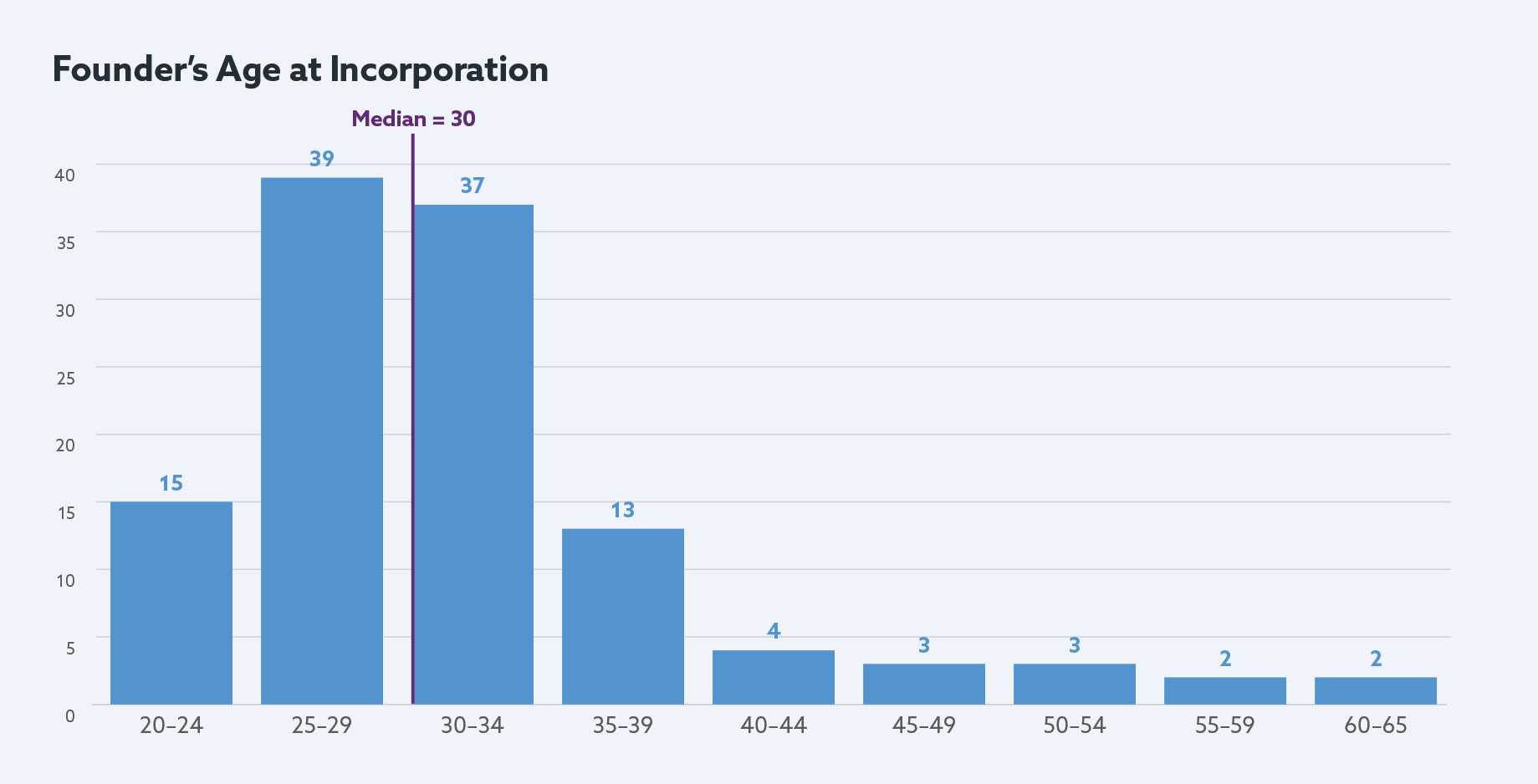
For 118 of our 124 founder positions, we could determine the founder's age at incorporation, mainly because most founders were or still are managing directors or management board members of their unicorn, which means their date of birth is publicly available in the German commercial register.
German unicorn founders may still be feeling 22 when they enter the start-up hustle, but their average age at incorporation is actually 31.7 years, with a median of 30. The span is wide: our youngest founders were 20 at incorporation, our oldest 65. Still, the typical German unicorn founder is neither a teenager nor a seasoned executive: he or she (overwhelmingly he) is in their early thirties.
This makes the German cohort somewhat younger than the international benchmark: research on start-ups valued at USD 1 billion or more, including Ali Tamaseb's 2021 book "Super Founders – What Data Reveals About Billion-Dollar Startups", puts the median age of their founders at somewhere around 34. A gap of four years is worth noting, but it does not change the overall picture: the Gates and Zuckerberg stories notwithstanding, unicorns are rarely built by teenagers or 22-year-olds.
III. Education: The Myth of the College Dropout
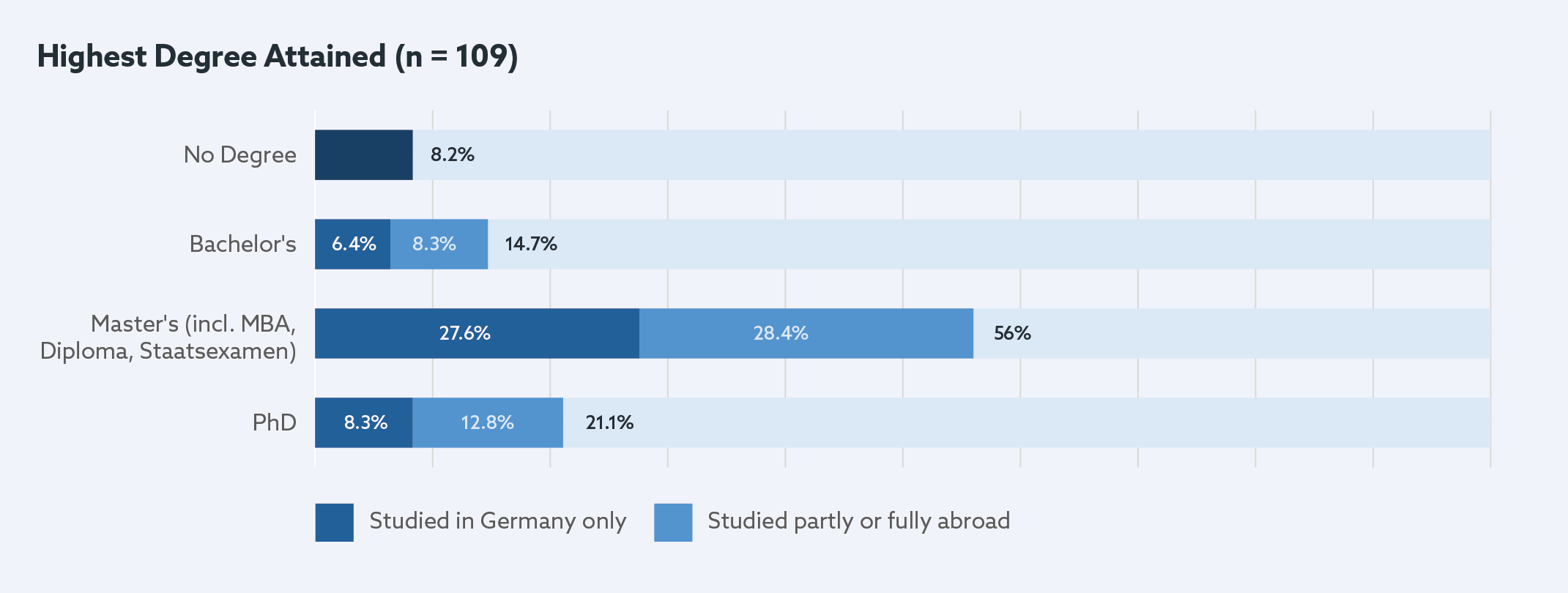
Let's start with the myth-busting: the college dropout is the exception, and the typical German unicorn founder is, if anything, overqualified. Only nine of the 123 founders have no college degree of any kind, counting bachelor's degrees, master's degrees, state examinations and the German Diplom alike. Three of them completed vocational training (Ausbildung) instead, among them commercial training and a motor vehicle mechanic apprenticeship.
Skipping university may look like a path "without a Plan B", but these founders are in good company. We already mentioned Mark Zuckerberg and Bill Gates. Further examples include Sam Altman who left Stanford in 2005 after two years of computer science and later co-founded OpenAI, and Melanie Perkins who left the University of Western Australia without completing her degree to build Canva.
The aggregate picture, here as elsewhere, points the other way: 114 of the 123 German founders (92.7 %) completed a degree, somewhat below the 97 % of 200 leading unicorn founders worldwide found to hold a college diploma, according to a 2023 study by the global entrepreneur network Endeavor.
Multiple degrees are the norm rather than the exception as well: around 46 % of all unicorn founders hold both a bachelor's and a master's degree, and at least 12 % hold more than one bachelor's or more than one master's degree; one of them, for example, combines a master's in physics with a master's in global affairs. At the top of the scale, more than 20 % of the founders whose highest degree we were able to determine hold a doctorate. This figure needs two caveats: some of those recorded were only research assistants or began a doctorate without a verifiable degree, and a few founders apparently dropped out of their Ph.D. program to found their company instead.
Much of this information is, of course, self-reported, and while we have no reason to doubt our founders, a CV is not a certificate. Remember former Yahoo CEO Scott Thompson (for our Gen Z readers: Yahoo was the Google of the 1990s) who learned this the hard way in 2012, when the computer science degree on his résumé turned out to be an accounting degree "only", and he stepped down shortly after.
Our founders also have considerable international exposure: approximately 50 % of the founders whose education we could trace studied entirely or partially at non-German universities. This is broadly comparable with the global picture, although the benchmarks are not measured identically. Per the Endeavor study mentioned above, 60 % of the top 200 unicorn founders studied or worked abroad (a broader measure than ours, which covers education only), and nearly a quarter of U.S. unicorn founders earned at least one degree abroad. Research published by the Association of American Universities points in the same direction: 21 % of the founders in its study of more than 1,000 U.S. unicorns completed their education internationally.
Overall, our findings and the cited research fit data from the Stanford Venture Capital Initiative, which also found that unicorn founders are better educated than average: compared with the average American over 25, they are six times as likely to hold a doctoral degree, three times as likely to hold a master's degree and twice as likely to hold an undergraduate degree.
IV. Where Do Unicorn Founders Meet?
Universities matter twice over in this cohort. They often supply the qualification, and for many teams they also supply the co-founder. For a number of these teams, the decisive encounter apparently happened on campus (or at a nearby party – the history books are not always accurate in this regard…) rather than in an office or at an investor event: in a chair's research group, in a student engineering initiative, in a joint honors program or simply in the same cohort of a master's degree. The ranking of the universities most frequently attended by our founders is therefore not merely a ranking of reputations. It is also a map of the places where German unicorn teams are formed, and where the next ones are presumably sitting side by side right now.
Two features of that ranking stand out. It is dominated by publicly funded universities, in particular technical ones, with the WHU being the only private institution in it. And Munich is heavily over-represented, with the TUM, the LMU and the CDTM, the honors program run jointly by both Munich universities, accounting for 36 entries between them (as founders may appear for more than one institution, the figures count entries rather than individual founders).
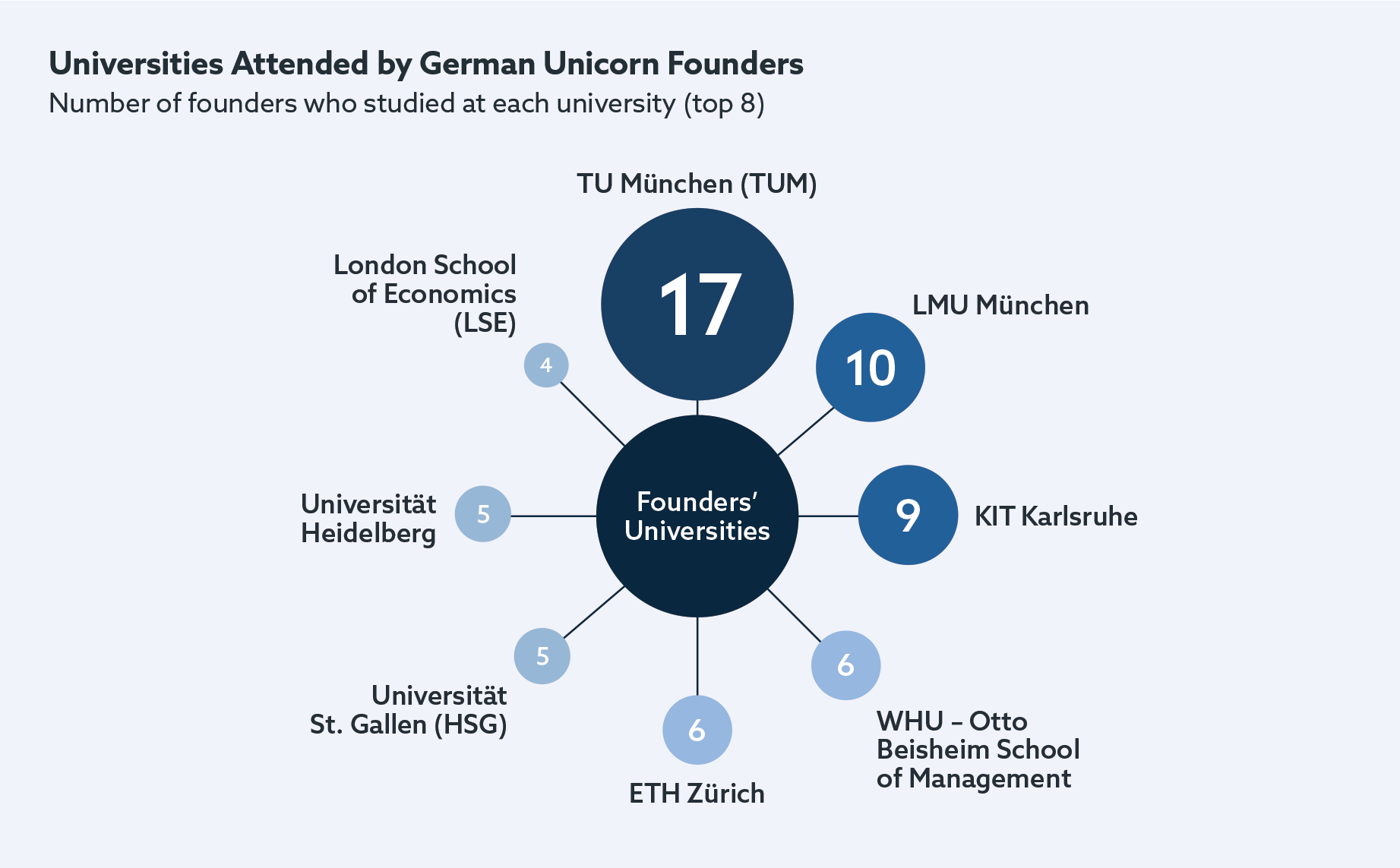
So, did these founders actually meet on campus? Of the 34 German unicorns with more than one founder, 19 (55.9 %) have at least two founders who attended the same university. While this does not prove that they met there, chances are good that at least some of these teams were formed in a lecture hall.
If university is where many teams may have formed, prior founding experience is what most of them lacked: of the 124 founder positions, 92 were held by first-time founders, while the other 32 (25.8 %) were held by founders who had already founded one or more start-ups, most of whom left their previous venture to found the unicorn. That makes serial founding noticeably rarer in Germany than in the global cohort, where, according to the Endeavor study cited earlier, about 49 % of the leading unicorn founders had started a business before.
What the German founders do bring instead is professional experience: 91 founder positions (73.4 %) were held by founders who had worked before founding their unicorn, 23 by founders who started straight out of university, and for the remaining ten (around 8 %) this could not be validated. That matters, because international data suggests that professional experience is a decisive factor: the average top international unicorn founder had gained a decade of work experience after graduating, and an analysis of more than 2,000 founders of U.S. unicorns, reported by Bizwomen, puts the figure at 13.7 years in 2025, up from 8.1 years in 2010.
Halftime: The Herd So Far
So, what have we learned so far? Germany's unicorn herd is mostly GmbH-born, rooted in Berlin and Munich. Its founders are overwhelmingly male, in their early thirties, highly educated and internationally minded – and, while most of them are first-time founders, most bring many years of professional experience. Many of them, as we have seen, attended the same university as at least one co-founder.
But meeting the right people is only the first step. The more delicate questions follow once the team is formed. That's where Part II picks up: We will look at how many co-founders joined forces, how they split the equity pie, who has stayed on board and who has said goodbye to their "baby", and what all of this tells us about who leads the herd. Stay tuned!
In this context, please also refer to the following OLNS Guides and OLNS Snapshots:
- OLNS#15 – Founder Teams in German Start-ups – Team Size and Composition / Equity Splits / Empirical Data
- Legal Ninja Snapshot: #Founder Teams in German Start-ups – Part II: Founder Equity Distribution Patterns
- Legal Ninja Snapshot: #Founder Teams in German Start-ups – Part I: Team Size and Gender Distribution
And if you really don’t want to wait, here is the full OLNS German Unicorn Census 2026.